Graphic Design Portfolio Examples: What Good Case Studies Show
Graphic design portfolio examples explained: six case study models for branding, packaging, posters and social media, plus what reviewers check in each one.
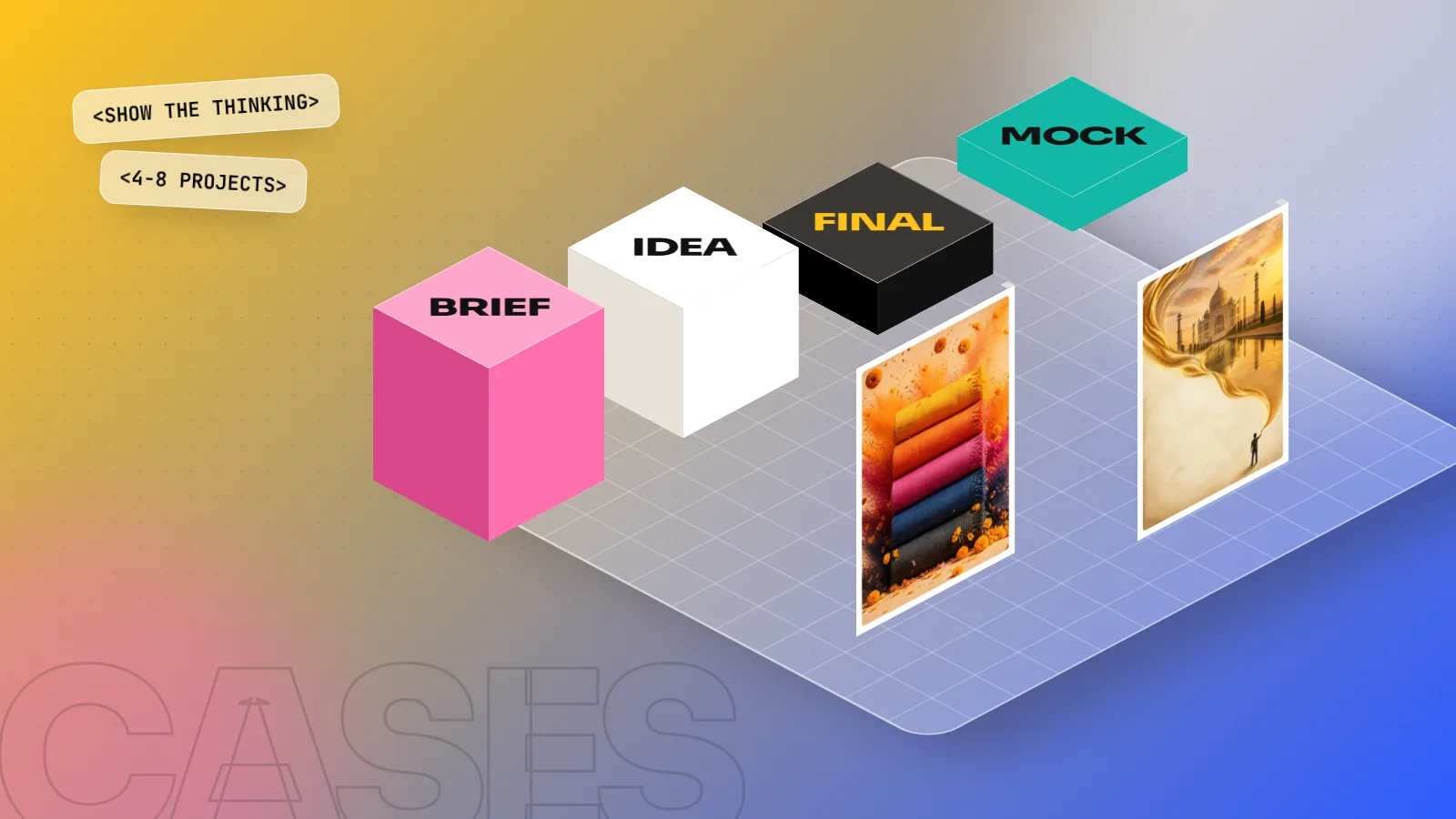
Good graphic design portfolio examples are short case studies, not galleries. Each shows the brief, early sketches, the final design, real-world mockups and a few lines on why choices were made. Strong portfolios hold four to eight such projects across branding, packaging, print and social media, matched to the job the designer wants.
People search for graphic design portfolio examples because a blank portfolio is hard to start. The useful thing to copy from a good example is not its colours or layout. It is the structure: each project is a short case study that shows a brief, the thinking, the final work and how it looks in real use. This guide breaks down six model case studies, explains what reviewers check in each and shows the mistakes that make good work look weak.
What every strong portfolio example has in common
The US Bureau of Labor Statistics says employers rely on portfolios when they hire graphic designers and that candidates should show creativity and originality. In practice, hiring managers spend only a short time on each portfolio, so the work has to explain itself quickly.
Across good portfolios, the same pattern repeats:
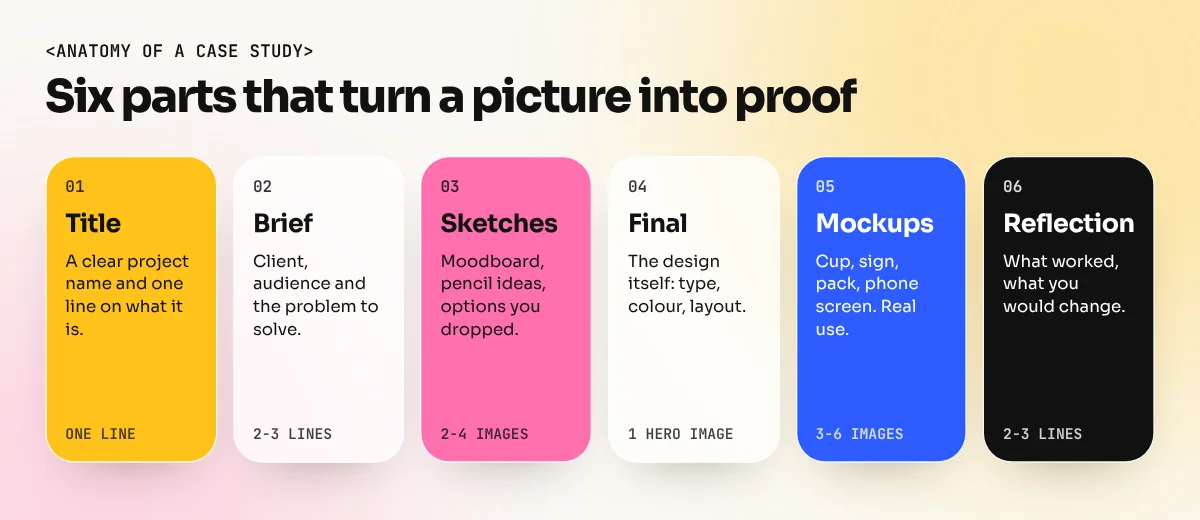
| Part of a project | What it shows the reviewer | Keep it to |
|---|---|---|
| Title and one-line summary | You can describe your own work clearly | One line |
| The brief | You understand problems, not just tools | Two or three lines |
| Research and sketches | How you think before you design | Two to four images |
| Final design | Your craft: type, colour, layout | One hero image |
| Applications and mockups | The idea works in the real world | Three to six images |
| Result or reflection | You can judge your own work | Two or three lines |
Notice that the text is short. Reviewers want to see the work, with just enough words to understand it.
Six portfolio case study examples
The six examples below are model projects. They are the kind of case studies a fresher can build from concept briefs, described part by part so you can follow the same structure with your own ideas.
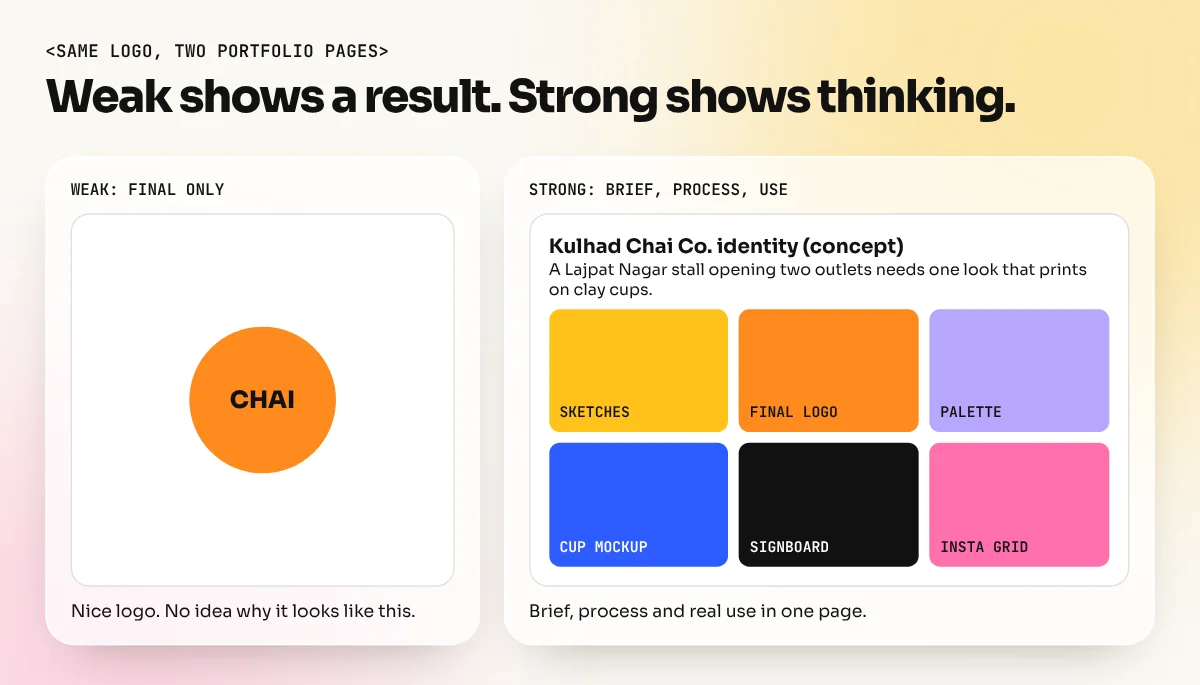
Example 1: Brand identity for a local chai brand
- Brief: A kulhad chai stall in Lajpat Nagar wants to open two more outlets and needs one look across all of them.
- Process: Photos of the existing stall, a moodboard of clay textures and old Delhi signage, three logo directions in pencil.
- Final: A one-colour logo that prints cleanly on clay cups, a two-colour palette and one display font.
- Applications: Cup print, shop signboard, menu board, delivery bag and an Instagram profile grid.
- Why it works: It shows the logo surviving tough conditions: tiny on a cup, huge on a sign, black and white on a printout.
Example 2: Packaging for a spice range
- Brief: A family spice business wants supermarket packs that stand out next to big brands.
- Process: Photos of the store shelf, a comparison of competitor colours, a die-line drawn to the real pouch size.
- Final: A pack system where one layout holds five spices, each with its own colour.
- Applications: Front and back of each pack, a shelf view and a shipping carton.
- Why it works: It proves you can design a system, not just one pretty pack and it shows print knowledge through the die-line.
Example 3: Festival poster campaign
- Brief: A college fest needs posters, social posts and entry passes with one shared look.
- Process: Thumbnail sketches, a type test and a grid for the main poster.
- Final: An A2 poster with clear hierarchy: event name, dates, venue.
- Applications: Instagram post and story versions, a printed entry pass and a banner on the college gate.
- Why it works: It shows one idea adapted across many sizes without losing the message.
Example 4: Social media campaign for a clothing brand
- Brief: A small ethnic wear label wants a festive campaign that looks premium on Instagram.
- Process: Analysis of the brand's current feed, a content plan of nine posts and a colour story.
- Final: Templates for product, offer and quote posts.
- Applications: The full nine-post grid shown on a phone mockup, plus two story designs.
- Why it works: Most junior jobs in India include social media work, so this example speaks directly to employers.
Example 5: Editorial layout
- Brief: A city magazine needs a four-page feature on Delhi street food.
- Process: A 12-column grid, a type scale and photo crops.
- Final: Two spreads with a strong opening page and readable body text.
- Applications: Printed spreads photographed on a table, plus a mobile version of the opening page.
- Why it works: It proves you can handle long text, grids and typography, skills that many beginners skip.
Example 6: Redesign of a real public item
- Brief: Make a confusing local notice or form easier to read.
- Process: A photo of the original, a list of what confuses people and two rough fixes.
- Final: A clearer version with better hierarchy and spacing.
- Applications: Before and after, side by side.
- Why it works: Before and after comparisons show your judgement instantly. Label it clearly as an unofficial concept.
Which examples to include for which job
You do not need all six. Pick the projects that match the work you want.
| Target job | Lead with | Also include | Can skip |
|---|---|---|---|
| Branding studio | Brand identity, packaging | Poster campaign | Social media grid |
| Advertising agency | Poster campaign, social campaign | Brand identity | Editorial layout |
| In-house brand team | Social campaign, packaging | Redesign | Editorial layout |
| Publishing or media | Editorial layout | Poster campaign | Packaging |
| Freelance work | Brand identity, social campaign | Packaging | Redesign |
Put your strongest and most relevant project first and your second strongest last. Reviewers remember the start and the end.
Where to show your portfolio
Most designers keep at least two versions of the same work.
- Behance. Free, widely used by recruiters and easy to share. Each project becomes a scrolling case study. Our guide to building a Behance portfolio covers image sizes and cover design.
- Your own website. Adobe's help pages say Adobe Portfolio is included in most Creative Cloud plans, so many designers use it for a simple site. Other site builders work too.
- A PDF portfolio. Useful for email applications and interviews. Keep it to around 10 to 15 pages and a small file size so it opens quickly on a phone. Build it in InDesign so text stays sharp.
Mistakes that make good work look weak
- Showing only final images. A logo on a white background tells the reviewer nothing about your thinking. Add the brief and a few sketches.
- Too many projects. Ten average projects hide the three good ones. Cut hard.
- Mockups that look fake. Over-glossy, badly lit mockups distract from the design. Choose simple, realistic ones.
- Long paragraphs. Nobody reads a 500-word story about a logo. Keep text to a few lines per section.
- Copied tutorial work. Reviewers recognise popular tutorials. Use tutorials to learn, then make your own brief.
- Not labelling concept work. If a brand did not hire you, say "concept project". Honesty builds trust.
- No contact details. Put your email and phone number on the first and last page of a PDF and in your profile.
How to build your first examples
If you have no projects yet, start with briefs you can believe in: a local shop, a family business, a cause you care about. Do three or four practice pieces in each area, then choose the best ones to develop into full case studies. Pair the portfolio with a clean one-page graphic designer resume that points to it.
Our 6-month graphic design diploma builds a portfolio as part of the course, with trainers reviewing each case study before it goes online. If you mainly want to lay out a sharp PDF portfolio, magazine spreads and brochures, the Adobe InDesign course covers grids, type styles and print-ready export.
The bottom line
The best graphic design portfolio examples are not the flashiest. They are the clearest. Four to eight projects, each with a brief, a little process, a strong final design and real-world mockups, will do more for your job search than fifty loose images. Use the six models above, swap in your own ideas and let the structure do half the work for you.
Frequently asked questions
How many projects should a graphic design portfolio have?
Four to eight strong projects is a common range. Fewer than four looks thin; more than eight usually means weaker pieces are included. Quality and clear thinking matter more than the count.
Can I show concept projects in my portfolio?
Yes. Label them as concept or self-initiated work and treat them like real briefs with a client, audience and goal. Never present a concept as paid client work.
Should my portfolio be a PDF or a website?
Keep both if you can. A website or Behance profile is easy to share, while a PDF of 10 to 15 pages is handy for email applications. Many designers build the PDF in InDesign so the layout stays sharp.
What should I leave out of my portfolio?
Leave out tutorial copies, work you cannot explain, weak early pieces and anything that does not match the job you want. One average project can lower the impression made by three good ones.