Work from Home as a Graphic Designer: Real Options, Setup and First Steps
Work from home graphic designer guide: the four real ways to earn, the laptop and software you need, where to find remote work and the scams to avoid in India.
Yes, you can work from home as a graphic designer. The four real routes are a remote job with a company, freelance clients, contract work through agencies and selling templates or assets. Most start with an office job, build a real portfolio, then go remote with a good laptop, licensed software and stable internet.
Yes, you can work from home as a graphic designer, but it works best after you have real skills and a portfolio. A work from home graphic designer usually earns in one of four ways: a remote job with a company, freelance clients, contract work for agencies or selling ready-made templates. This guide explains each route, the setup you need, where remote work is found in India and the scams to stay away from.
Is work from home graphic design a real career?
It is. Design work is done on a computer, files travel over email and cloud drives and feedback happens on calls. That makes it one of the easiest creative jobs to do remotely.
The data also shows how common independent work is in this field. The US Bureau of Labor Statistics, in its Occupational Outlook Handbook, lists self-employed workers as the largest single group of graphic designers, at about 20 per cent of all jobs. Many of those self-employed designers work from a home studio.
In India the pattern is similar. Small brands, coaching centres, restaurants, D2C startups and agencies in Delhi, Gurugram, Noida, Mumbai and Bengaluru all need a steady flow of social posts, packaging, menus and ads. Many of them are happy to work with a designer they never meet, as long as the work is good and on time.
The honest catch: remote work rewards designers who already work independently. Nobody sits next to you to fix a wrong font or a low-resolution image. That is why most designers start with an office or hybrid job, then go remote.
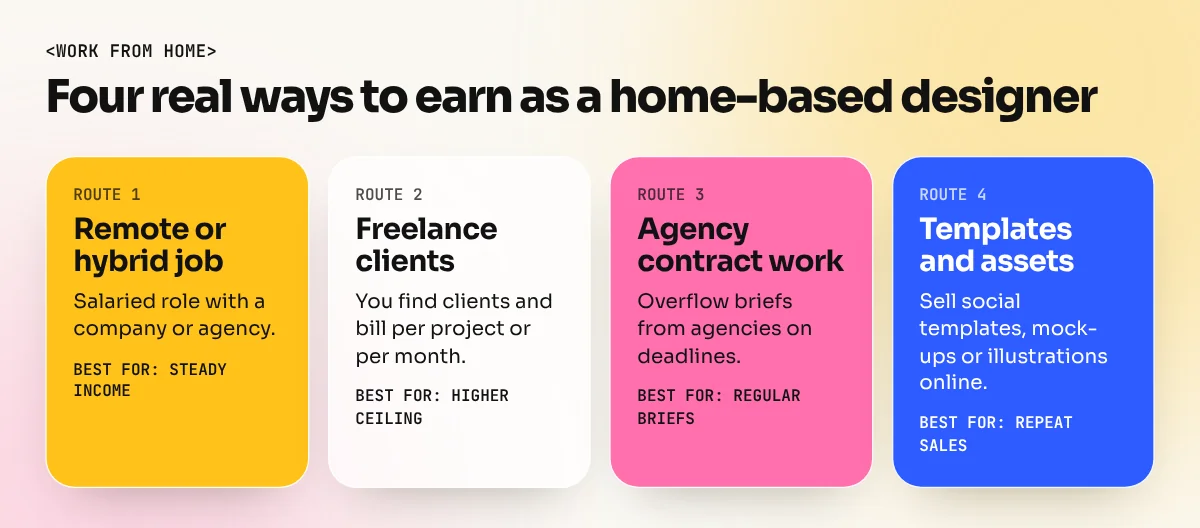
Four real ways to work from home as a designer
| Route | How it works | Good for | Watch out for |
|---|---|---|---|
| Remote or hybrid job | Salaried role with a company or agency, work from home full time or some days | Steady income, learning from seniors | Fewer fully remote roles for freshers |
| Freelance clients | You find clients directly and bill per project or per month | Higher earning ceiling, choice of work | Irregular income, chasing payments |
| Contract work for agencies | An agency gives you overflow work on deadlines | Regular briefs without finding clients | Tight deadlines, agency owns the client |
| Selling templates and assets | Sell social media templates, fonts, mock-ups or illustrations online | Income that keeps coming after one effort | Slow start, needs many products |
Most working designers mix two of these. A common pattern is a part-time retainer with one local brand plus project work from an agency.
The setup you actually need at home
You do not need an expensive studio. You need a setup that never lets a client down.
- A laptop or desktop that runs Adobe apps smoothly. Look for at least 16 GB RAM, an SSD and a screen with good colour. Photoshop with many layers and Illustrator with complex vectors slow down badly on 8 GB machines.
- Licensed software. Clients send and expect Photoshop (PSD), Illustrator (AI) and print-ready PDF files. A Creative Cloud plan, plus Canva for quick social work, covers most briefs. Cracked software can carry malware and can get a client's work flagged.
- Stable internet with a backup. Broadband for daily work and a phone hotspot for power cuts. Large files and video calls need reliable upload speed, not only download speed.
- Power backup. An inverter or UPS for the laptop and router saves deadlines during summer power cuts.
- Cloud storage and a file system. Name files clearly (client_project_v3_final.pdf) and keep backups. Losing a client's source file once can lose the client.
- A quiet corner for calls. A clean background and a decent headset make you look as professional as an agency.
Skills that matter more when you work remotely
Software skill gets you hired. These habits keep you hired when nobody can see you working:
- Reading a brief well. Ask the right questions at the start: size, platform, deadline, brand colours, what must appear and who will approve.
- Clear written updates. Send a short message when you start, when a first draft is ready and when files are delivered.
- Print knowledge. Bleed, CMYK, resolution and fonts converted to outlines. Remote clients often send files straight to the printer without checking.
- Speed with templates and brand kits. Social media clients want 15 to 30 posts a month in the same style. A good system matters more than one perfect post.
- Basic AI tools. Photoshop Generative Fill and AI image tools speed up backgrounds, mock-ups and clean-ups. Clients now expect faster turnarounds because of this.
- Saying no politely. Endless revisions kill remote income. Write down how many rounds of changes are included before you start.
Where to find work from home graphic design jobs
Start with places where real companies post work and build your own pipeline at the same time.
| Source | What you find there | Tip |
|---|---|---|
| Job portals (Naukri, LinkedIn, Indeed) | Remote and hybrid salaried roles | Use the "remote" or "work from home" filter and set alerts |
| LinkedIn posts | Founders and agency heads asking for designers | Comment with a short note and one relevant project |
| Freelance platforms (Upwork, Fiverr) | Project work from clients in India and abroad | Check each platform's current fee page before you price |
| Behance and Dribbble | Clients who find you through your portfolio | Post full case studies, not single images |
| Local businesses | Social media, menus, packaging, signage | Your first steady retainers often come from here |
| Design and marketing agencies | Overflow work on deadlines | Send a one-page portfolio PDF and your rates |
| Your own network | Friends' businesses, ex-colleagues | Tell people clearly what you design |
How to start if you are a beginner
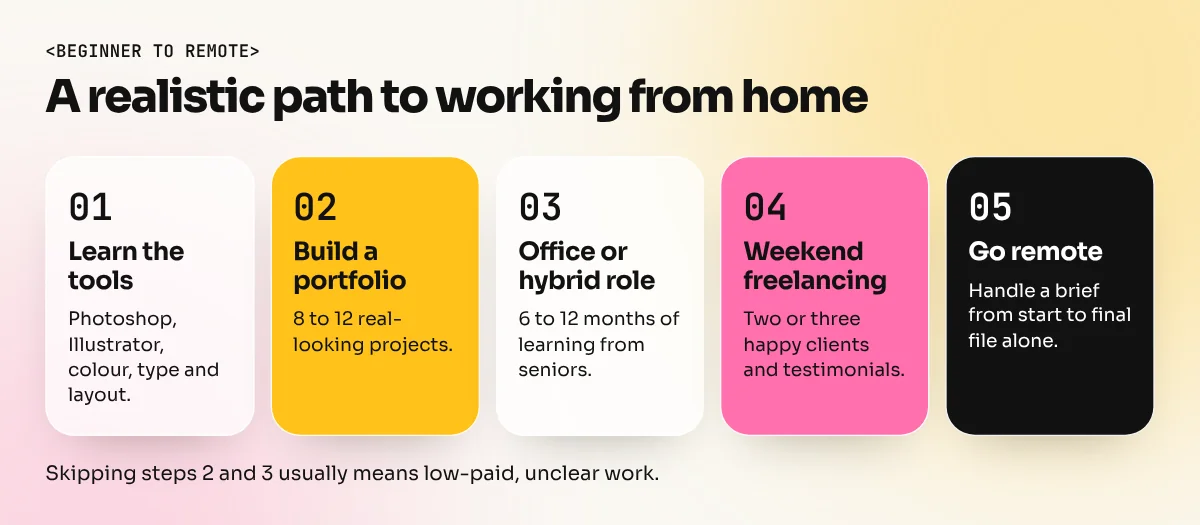
Going straight to "work from home" with no experience usually means low-paid, unclear work. A better order:
- Learn the core tools properly. Photoshop, Illustrator and the basics of layout, colour and typography. Our guide on how to learn graphic design maps out the order.
- Build 8 to 12 real-looking projects. A logo with a brand kit, a set of social posts, a menu, a leaflet and packaging. See how to build a graphic design portfolio with no experience.
- Take an office or hybrid role for 6 to 12 months if you can. You learn client handling, print problems and speed from seniors.
- Take small freelance projects on weekends. Two or three happy clients give you testimonials and confidence.
- Move to remote or freelance work once you can handle a brief from start to final file without help.
If you cannot travel to a classroom, our live online graphic design classes teach the same tools one-to-one with a trainer. The full 6-month graphic design diploma adds portfolio projects and placement support.
Work from home scams to avoid
Remote design work attracts fake offers. Watch for these signs:
- They ask you to pay first. A registration fee, a "software kit" or a refundable deposit. Real employers pay you; you never pay them.
- Tasks that are not design. "Like and share", "rate this product" or "copy-paste" work sold as design jobs on WhatsApp or Telegram.
- No company name, no website, no video call. A real client can tell you who they are and talk to you.
- Huge pay for simple work. If the money sounds too good for a few hours, it is.
- Free "test" work that is a full project. A short test is normal. A complete campaign for free is not.
Also protect your own work. Send watermarked or low-resolution previews until payment is cleared and take a part payment before you start with new clients.
Money, invoices and tax basics
Keep this simple and legal from day one:
- Agree the price in writing before starting: what is included, how many revisions and the delivery date.
- Send a proper invoice with your name, address, PAN, the work done and the payment terms.
- Keep records of every payment in one bank account.
- GST: under the GST rules explained by CBIC, service providers in most states must register once yearly turnover crosses Rs 20 lakh (Rs 10 lakh in special category states). Turnover from clients abroad counts towards that total.
- Income tax: freelance income is taxable. A chartered accountant can tell you which form and which expenses apply to you.
The bottom line
Working from home as a graphic designer is real, common and very doable in India. It is not a shortcut, though. Clients pay remote designers who deliver clean files on time without hand-holding. Learn the tools well, build a portfolio, get some real experience, then set up a reliable home studio. The freedom comes after the skill.
Frequently asked questions
Can a fresher get a work from home graphic designer job?
It is possible but harder. Most companies want freshers in the office for the first months so a senior can guide them. A strong portfolio, quick replies and small freelance projects improve your chances of getting a remote role early.
Which software do I need to work from home as a graphic designer?
Most clients expect Adobe Photoshop and Illustrator files. InDesign helps for brochures and books, Canva for quick social posts and Figma for app or website work. Use licensed software, because client work on cracked software is a legal and security risk.
Are work from home graphic design jobs on WhatsApp real?
Be careful. A real employer never asks you to pay a registration fee, buy a kit or deposit money before you get tasks. If a message offers high pay for simple "like and share" or "data entry design" work, it is almost always a scam.
Do I need GST registration as a freelance designer?
Under GST rules, service providers in most states must register for GST once yearly turnover crosses Rs 20 lakh (Rs 10 lakh in special category states). Below that, registration is optional. Ask a chartered accountant for your own case.