Freelance Graphic Designer Jobs: First Clients, Pricing and Contracts
Freelance graphic designer jobs in India explained: where first clients come from, how to price work, what a simple contract must say and how to get paid on time.
Freelance graphic designer jobs come from three places: people you already know, local businesses you approach directly and freelance platforms. Start with a small portfolio of real work, price by the project instead of the hour, take 50 percent in advance and put the scope, revisions and payment dates in writing before you open any software.
Freelance graphic designer jobs are real paid projects for clients who hire you job by job instead of employing you full time. Your first clients will usually come from people you know, local businesses you contact yourself and freelance platforms, in that order. What decides whether freelancing works is not talent alone. It is how you find clients, how you price, what you put in writing and how you collect payment. This guide covers all four, with simple tables and checklists you can use from your first job.
What a freelance graphic designer actually does
A freelancer runs a very small business with one employee. You design, but you also sell, write quotes, answer messages, send invoices and follow up on payments. Plan for that from day one.
Freelancing is a normal part of design work worldwide. The US Bureau of Labor Statistics reports that about 20 percent of graphic designers in the United States are self-employed. In India, freelance demand comes mostly from small businesses that cannot hire a full-time designer: shops, restaurants, coaching centres, clinics, startups and personal brands on Instagram.
| Common freelance job | Typical client | What you deliver |
|---|---|---|
| Logo and visiting card | New shop, consultant, startup | Vector logo files, print-ready card |
| Social media posts | Cafe, salon, gym, coach | A monthly set of posts and stories |
| Menu or price list | Restaurant, dhaba, bakery | Print-ready PDF and a phone version |
| Packaging and labels | Home food brand, small D2C brand | Label artwork with dieline and bleed |
| Wedding and event cards | Families, event planners | Print files and a WhatsApp version |
| Brochure or flyer | Builder, school, clinic | Print-ready PDF |
If you want to know the other ways to earn from home, such as remote jobs and template selling, read our guide to working from home as a graphic designer. This post stays on the freelance route.
Before you look for clients: the minimum you need
Clients hire freelancers by looking at work, not certificates. Before you send a single message, have these ready:
- Six to eight portfolio pieces in the kind of work you want to be paid for. If you want menu jobs, show menus. A strong set of student or self-set projects is fine to begin with. Our guide on building a graphic designer portfolio with no experience shows how.
- One clear offer. "I design logos and visiting cards for new shops in South Delhi" is easier to say yes to than "I do all kinds of design".
- A simple quote and invoice template with your name, contact, a quote number and payment details.
- A short brief form. Five or six questions you ask every client: business, customers, what they need, where it will be used, deadline and budget.
- Licensed software and a reliable laptop. Clients will ask for editable files, so you need the real tools.
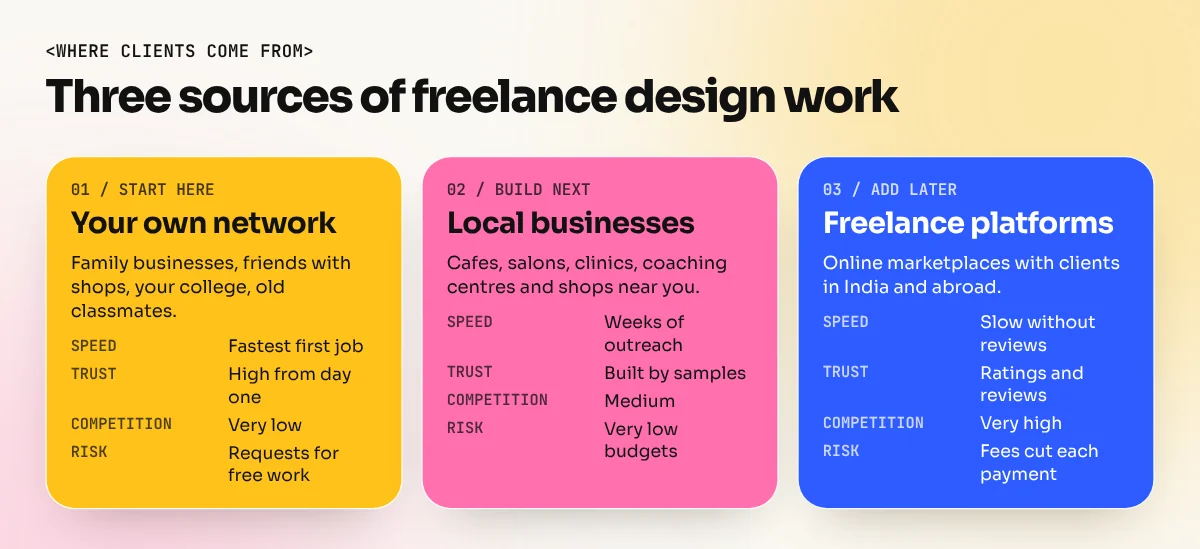
Where freelance graphic designer jobs come from
Beginners often go straight to big freelance platforms and get discouraged. Those platforms are useful, but they are not usually where the first clients come from.
| Source | How to start | Good for | Watch out for |
|---|---|---|---|
| Your own network | Tell 30 people what you do, with 3 samples | First paid jobs, trust, referrals | Friends asking for free work |
| Local businesses | Walk into shops near you, or message them with one idea for their brand | Repeat monthly work | Saying yes to very low budgets |
| Instagram and LinkedIn | Post your work and the process behind it twice a week | Being found by the right clients | Months before it brings leads |
| Freelance platforms | One focused profile, a few well-written proposals a day | Overseas clients, steady volume | Platform fees, heavy competition |
| Other designers and agencies | Offer to take overflow work | Regular projects | Lower rates, tight deadlines |
A useful habit: every time a job ends well, ask the client for two things. A short line you can quote on your profile and the name of one other business owner who might need design. Referrals are how most freelancers stay busy.
How to price freelance design work
Pricing is where most new freelancers lose money. They guess a number, the client says yes too quickly and the job takes three times longer than planned. Use a simple method instead.
- Work out your hourly number. Add your monthly costs (software, internet, electricity, phone, laptop savings) and the money you need to live. Divide by the hours you can really bill in a month. Many freelancers can bill only half their working hours, because the rest goes on messages, quotes and admin.
- Estimate the hours for the job. Include the brief call, research, sketches, design, two revision rounds and file export.
- Multiply and round up. Hours times your hourly number gives your base price. Add a margin for a client who is slow to reply.
- Quote one project price, not an hourly rate. Clients in India usually prefer to know the full amount upfront.
- Offer three packages where it makes sense. For example, logo only, logo with visiting card and a full starter kit with social media templates. Most clients pick the middle one.
| Pricing model | How it works | Best for |
|---|---|---|
| Per project | One fixed price for an agreed scope | Logos, menus, packaging, brochures |
| Monthly retainer | Fixed fee for a set number of posts or hours each month | Social media and ongoing brand work |
| Per hour | Billed for the hours you log | Edits, overflow work for agencies |
| Per item | A rate per post, banner or page | Large batches of similar designs |
Raise your prices step by step. After every few happy clients with good results, quote new clients a little more. Your old rate should never become your permanent rate.
What your freelance contract must say
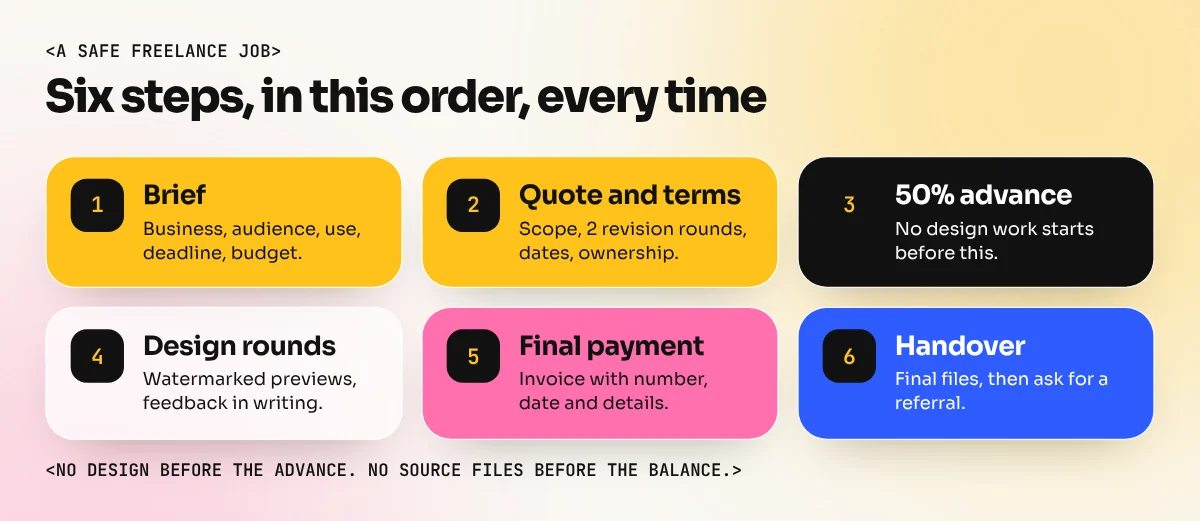
You do not need a lawyer for every small job, but you do need clear terms in writing. A one-page agreement, or a detailed email that the client replies "agreed" to, is far better than a phone call nobody remembers.
- Scope: exactly what you will deliver. "One logo in three file formats, one visiting card front and back."
- What is not included: printing, extra sizes, stock photos, website work.
- Revisions: how many rounds are included and the charge for extra rounds.
- Timeline: your delivery date and the client's dates for feedback. If they reply late, the deadline moves.
- Price and payment: total fee, advance (50 percent is common), balance due date and how they will pay.
- Files and ownership: final editable files are handed over after full payment. Say whether you can show the work in your portfolio.
- Cancellation: if the client stops the job midway, the advance covers the work already done.
Getting paid on time
Late payment is the most common freelance problem. A few habits fix most of it.
- Never start without the advance. A client who will not pay 50 percent upfront is often a client who will not pay the rest.
- Send watermarked or low-resolution previews until the balance is paid. Hand over final files only after full payment.
- Send a proper invoice with an invoice number, date, your details, the client's details, the work done, the amount and your payment details.
- Follow up politely on the due date, then again after three days. Keep it short and friendly.
- Keep records of every invoice and payment for tax filing.
On tax, freelance income is taxable like any other income. Under GST rules, service providers in most states must register once yearly turnover crosses Rs 20 lakh (Rs 10 lakh in special category states). Some business clients deduct TDS from your fee before paying you; that amount is credited against your PAN and you can claim it when you file your return. Rules change, so ask a chartered accountant about your own case.
Skills that keep freelance clients coming back
Clients rehire freelancers who make their life easy. Design skill gets you the first job. These get you the second and third:
- Fast, clear replies. Answer within a few hours, even if only to say when you will send the draft.
- Asking good questions at the brief stage, so the first draft is close to right.
- Clean files. Named layers, vector logos from Illustrator, correct CMYK print PDFs with bleed. Printers notice and clients hear about it.
- Presenting work well. Show the design on a mockup and explain your choices in two or three lines.
- Meeting deadlines. Being on time beats being brilliant but late.
For the tools side, logo and brand work makes up a large part of freelance jobs, which is why a solid Adobe Illustrator course pays back quickly. If you are starting from zero, the 6-month graphic design diploma covers the full set of tools, print and portfolio work that freelancers need.
Common mistakes new freelancers make
| Mistake | What happens | Better way |
|---|---|---|
| Starting work on a phone call | Scope grows, price stays the same | Written scope and a reply saying "agreed" |
| Unlimited revisions | Endless changes, no profit | Two rounds included, extra rounds charged |
| Very low prices to win jobs | You attract clients who bargain on everything | Fair price, clear package, good samples |
| Sending open files before payment | Client stops replying | Previews first, files after the balance |
| Doing free "test" designs | Your idea gets used without pay | Show past work instead, or charge a small paid trial |
| No savings buffer | Panic in slow months | Keep a few months of costs saved |
The bottom line
Freelance graphic designer jobs are a real way to earn, but they reward designers who treat freelancing as a small business. Build a focused portfolio, start with your own network and local shops, price by the project, put every job in writing and never hand over final files before you are paid. Do that consistently and referrals will slowly replace cold messages.
Frequently asked questions
How do I get my first freelance graphic design client?
Start with people who already trust you: family businesses, friends who run shops, your old school or college and local cafes. Offer a clear package, such as a logo with a visiting card, show two or three real samples and ask every happy client for a referral.
How much should a beginner freelance graphic designer charge?
There is no fixed rate. Work out the hours a job really takes, multiply by the hourly amount you need to cover your costs and living, then quote one project price. Check what local designers with similar portfolios charge and raise your price after every few happy clients.
Do I need a contract for small freelance design jobs?
Yes, even a one-page agreement or a clear email the client replies "agreed" to. It should list what you will deliver, the number of revisions, the price, the advance, the payment dates and who owns the final files after full payment.
Can I freelance while doing a full-time design job?
Many designers do, but read your job contract first. Some employers do not allow outside work, or do not allow work for competing clients. Keep freelance work to your own time and your own equipment.