Graphic Design Interview Questions With Sample Answers for Freshers
Graphic design interview questions asked in India with sample answers: portfolio, process, software, test tasks, feedback and the questions to ask back.
Most graphic design interview questions fall into five groups: about you, your portfolio, your design process, software skills and how you handle feedback and deadlines. Answer each one with a real project: the problem, what you did and the result. Expect a short test task too, so practise designing a social post or poster in 60 to 90 minutes.
Graphic design interview questions are mostly about five things: who you are, your portfolio, how you think, the software you use and how you work with people. If you can explain two or three of your own projects clearly, you can answer almost every question. This guide lists the questions asked in Indian agency, brand and studio interviews, with short sample answers you can adapt, plus the test task and the questions you should ask back.
How a graphic design interview works
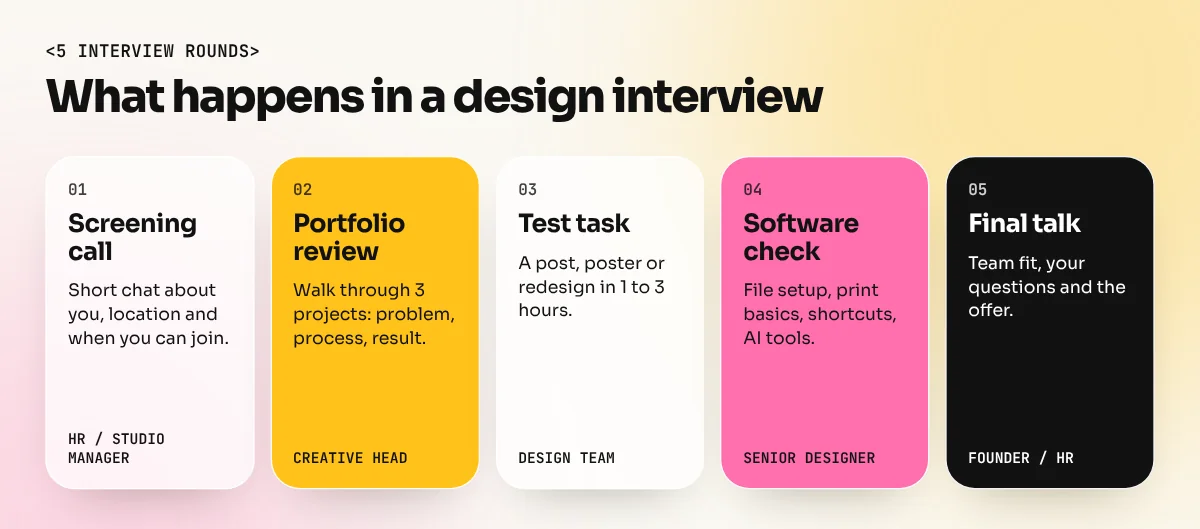
Interviews change from company to company, but most design hiring in India follows the same few rounds. A small studio may do all of them in one meeting. A bigger brand or agency may spread them over a week.
| Round | Who you meet | What they check | How to prepare |
|---|---|---|---|
| 1. Screening call | HR or the studio manager | Basic fit, location, notice period, expected start | Have a one-line summary of yourself ready |
| 2. Portfolio review | Senior designer or creative head | Quality, thinking and range | Pick 3 projects you can talk about in detail |
| 3. Test task | Design team | Speed, brief reading, file hygiene | Practise timed briefs at home |
| 4. Software check | Senior designer | Real skill in Photoshop, Illustrator, InDesign or Canva | Know shortcuts and file setup by heart |
| 5. Final talk | Founder, manager or HR | Attitude, team fit, salary talk | Research the company's recent work |
Questions about you
These open the interview. Keep your answers short and specific.
1. Tell me about yourself. Sample answer: "I am a graphic designer who mostly works on social media and print for food and retail brands. In my course I built a full identity for a Delhi tea stall, from logo to menu to Instagram posts. I want to join a team where I can work on real brand campaigns and learn from senior designers."
2. Why graphic design? Talk about a real moment, not a dream. For example, noticing how a well-made hoarding changed how you saw a brand, then wanting to make work like that.
3. Why do you want to work here? Look at the company's Instagram, website and recent campaigns before the interview. Name one piece you liked and say why. This one answer shows more interest than any line about "growth".
4. Where do you see yourself in two or three years? Be honest and connected to the job: "Handling a brand's design on my own, mentoring a junior and getting better at motion graphics."
Questions about your portfolio
This is the most important part of the interview. The person across the table wants to see how you think, not only what you made.
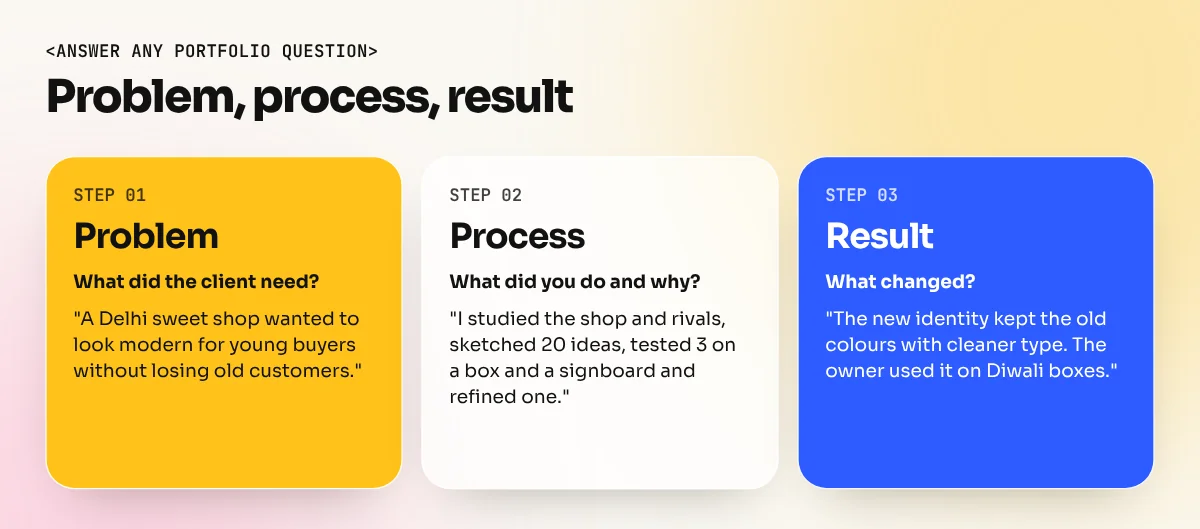
5. Walk me through this project. Use a simple three-part answer: problem, process, result.
- Problem: "A local sweet shop wanted to look modern for younger buyers without losing its old customers."
- Process: "I studied their shop, their competitors and their packaging. I sketched 20 logo ideas, picked 3, tested them on a box and a signboard and refined one."
- Result: "The final identity kept their traditional colours but used cleaner type. The owner used it on new boxes for Diwali."
If a project was a course exercise, say so. Honesty here builds trust.
6. Which project are you most proud of and why? Pick the one with the best story, not only the prettiest one. A project where you solved a real problem beats a nice poster with no brief.
7. What would you change in this project now? Interviewers love this question because it shows growth. Name one or two real flaws: "The headline is too small on mobile" or "I would use fewer colours."
8. Is all this work your own? Say exactly what you did. If you worked in a team, name your part. Never claim work you did not do. It is common for a senior designer to ask a follow-up that only the real maker can answer.
Questions about your design process
These check whether you work with a plan or only with software.
9. What is your design process? A clear answer: "I read the brief and write down the one message. I research the brand and the audience. I sketch ideas on paper, then pick two or three and build them on screen. I check them at real size, share with the client and refine based on feedback."
10. How do you start when you get a new brief? Mention questions you ask: Who is it for? Where will it be seen? What is the one thing people should remember? What is the deadline and the budget?
11. How do you choose colours and fonts? Tie your answer to the brand and the audience. "For a kids' brand I use bright, friendly colours and a rounded sans serif. For a law firm I use fewer colours and a classic serif." You can also mention checking contrast so text is easy to read and limiting yourself to two font families.
12. What are the principles of good design? Name a few and give one quick example each: hierarchy, alignment, contrast, balance, white space and consistency. Do not list ten words with no meaning behind them.
Software and technical questions
Expect a senior designer to test real skill. Some will open a file and ask you to do a task live.
| Question | What they are checking | Good short answer |
|---|---|---|
| Which software do you use for what? | You pick the right tool | Photoshop for photos, Illustrator for logos and vectors, InDesign for multi-page print |
| What is the difference between CMYK and RGB? | Print knowledge | CMYK is for print inks, RGB is for screens. I set the mode before I start |
| What is bleed? | Print-ready files | Extra image area past the trim line, usually 3 mm, so no white edges appear after cutting |
| Raster or vector for a logo? | Basics | Vector, so it scales from a visiting card to a hoarding without blur |
| How do you prepare a file for print? | File hygiene | Correct size, CMYK, 300 ppi images, bleed, fonts outlined or embedded, PDF/X export |
| Which AI tools do you use? | Up-to-date skills | Photoshop Generative Fill and AI image tools for drafts, then I finish the design myself |
| How do you name and organise files? | Team work | Clear names with client, job and version, plus one folder per project |
Revise CMYK, RGB and bleed the night before. They come up in almost every print studio and a confident one-line answer tells the interviewer you understand real print work.
The test task round
Many companies give a practical test. It might be a one-hour task in the office or a take-home brief. Common tasks include:
- A social media post or carousel for an upcoming festival
- A poster or leaflet for an event
- A redesign of one of the company's own old ads
- A simple logo or label for a made-up product
How to do well:
- Read the brief twice and underline the size, the format and the deadline.
- Ask one or two smart questions, such as who the audience is or where the design will run.
- Sketch first for five minutes. It saves time on screen.
- Keep it simple. One strong idea done cleanly beats three half-finished ideas.
- Check spelling, especially brand names and dates.
- Export properly: the right size, a clear file name and the working file if they ask for it.
- Write two or three lines explaining your idea when you submit.
A fair test task is short. If a company asks for a large amount of free work, such as a full campaign, it is fine to ask politely how the work will be used.
Questions about feedback, deadlines and clients
These questions check whether you are easy to work with. Answer each one with a real example.
13. How do you handle negative feedback? "I listen fully, ask what exactly is not working and note it down. Then I make the changes and explain anything I think should stay, with a reason. Feedback is about the work, not about me."
14. What do you do if a client keeps changing their mind? "I confirm the changes in writing after each call, show two clear options instead of many and agree on the number of revisions at the start."
15. Tell me about a time you missed a deadline or nearly did. Be honest. Say what happened, what you did and what you changed afterwards, such as breaking big jobs into smaller daily goals.
16. How do you handle many projects at once? Mention a simple system: a daily list, priorities by deadline and quick updates to your manager when something is late.
17. What salary do you expect? Research first on job portals for your city and level. Give a range rather than one number. Say you are open to discussing it based on the role.
Questions you should ask them
At the end you will hear, "Do you have any questions?" Always ask one or two. Good choices:
- What kind of projects would I work on in the first three months?
- Who would review my work and how often?
- Which software and AI tools does the team use?
- How does the team share feedback on designs?
Avoid asking only about leave and timings in the first meeting.
Mistakes that cost freshers the job
- Showing 30 average pieces instead of 8 to 12 strong ones
- Not being able to explain why you made a design choice
- A portfolio that does not open offline, or files that take ages to load
- Blaming old clients or teachers for weak work
- Copying a famous design and calling it your own
- Not knowing anything about the company
Two guides will help you fix most of these before the interview: how to build a graphic designer portfolio with no experience and how to write a graphic designer resume.
A one-week prep plan
- Day 1: Pick your best 8 to 12 projects. Remove anything weak.
- Day 2: Write the problem, process, result story for your top 3 projects.
- Day 3: Revise software basics: print setup, export settings and your 20 most used shortcuts.
- Day 4: Do one timed test task of 90 minutes, then review it honestly.
- Day 5: Practise answers to the questions above out loud, ideally with a friend.
- Day 6: Research the company's work and write two questions to ask them.
- Day 7: Check your laptop, PDF portfolio, resume and route to the office.
If you want structured practice, our 6-month graphic design diploma ends with portfolio work, interview practice and placement support and the graphic design course after 12th is built for students starting from zero. Interviews get easier with each one you sit. Treat every interview as practice and keep improving your answers.
Frequently asked questions
What questions are asked in a graphic designer interview for freshers?
Freshers are usually asked to walk through two or three portfolio projects, explain their design process, name the software they use and say how they handle feedback. Many companies also give a small test task, such as a social media post for a brand.
How do I answer "tell me about yourself" in a design interview?
Keep it under a minute. Say what kind of design you do, one project you are proud of and what you want to do next. Skip your school history unless they ask for it.
Do graphic design interviews have a practical test?
Many do. Agencies and brands often give a test task of one to three hours, or a take-home brief due in a day or two. Read the brief twice, ask one or two questions and submit clean, well-named files.
What should I bring to a graphic design interview?
Bring your portfolio on a laptop or tablet that works offline, a PDF copy, a one-page resume and a notebook. Keep two or three projects ready to open in seconds, with your sketches and early drafts.