10 Types of Graphic Design and the Jobs Behind Each
The 10 main types of graphic design explained simply: what each one makes, the tools it uses, the job titles behind it and how to pick the right one for you.
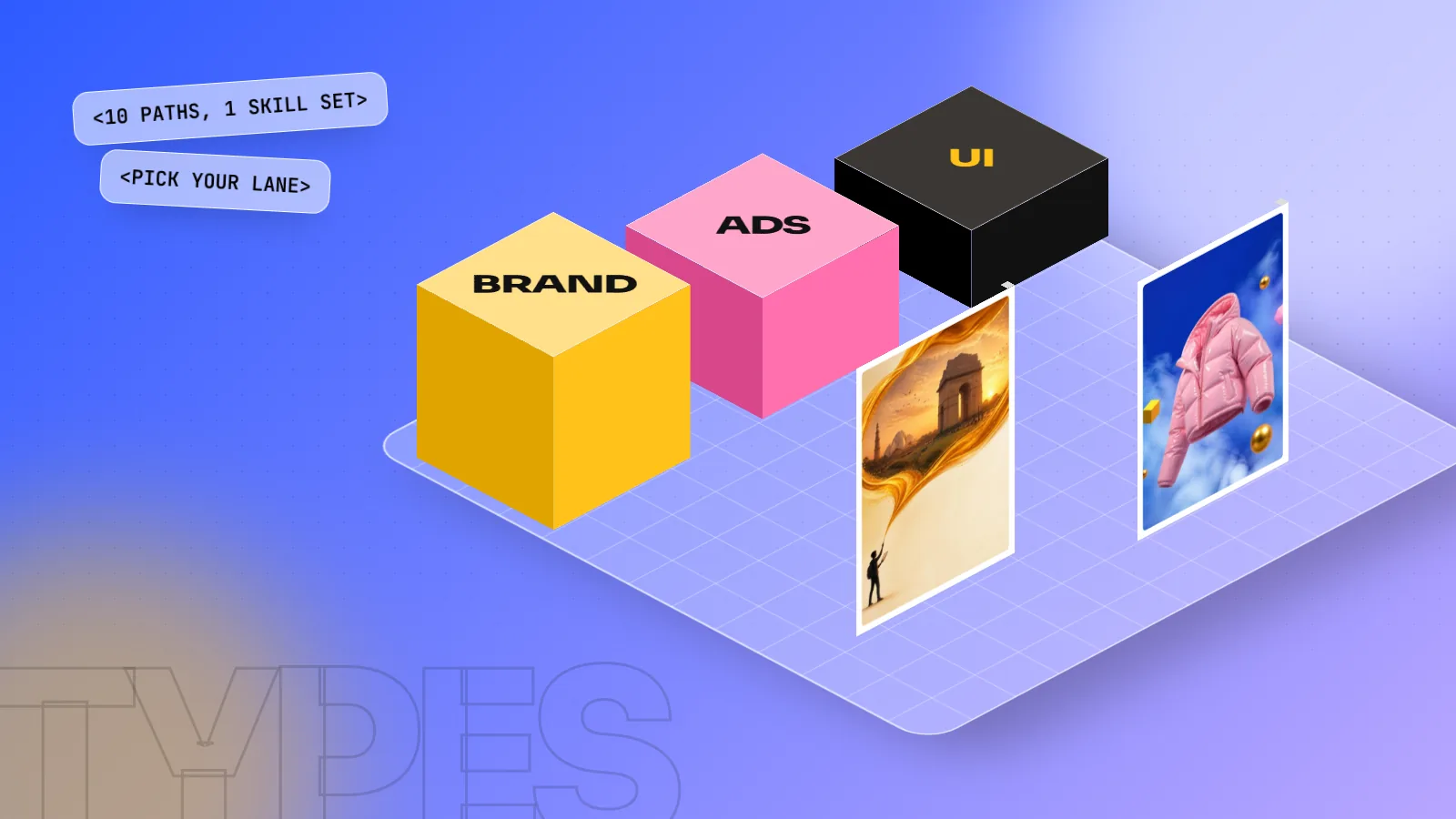
The main types of graphic design are brand identity, marketing and advertising, social media, packaging, publication, UI and web, motion graphics, environmental and signage, illustration and infographics and print production. Each one uses the same basics (colour, type, layout) but makes different things, uses different software and leads to different job titles.
The main types of graphic design are brand identity, marketing and advertising, social media, packaging, publication, UI and web, motion graphics, environmental design, illustration and infographics and print production. All of them use the same basics: colour, typography, layout and an idea. What changes is what you make, the software you open every day and the job title on your offer letter. This guide explains the 10 types of graphic design in simple words, with Indian examples and the jobs behind each, so you can pick your lane.
If you are new to the subject, start with our guide on what graphic design is. This post goes one step further and looks at each field as a career.
Why the type of graphic design you pick matters
A designer who makes Instagram posts for a café in Hauz Khas and a designer who builds the signage for a metro station both call themselves graphic designers. Their days look very different.
The type of graphic design decides:
- What you make: a logo, a reel, a box, a book, an app screen.
- Your tools: Illustrator for logos, InDesign for books, Figma for apps, After Effects for motion.
- Where you work: an ad agency, a brand's in-house team, a print house, a tech company or as a freelancer.
- What your portfolio must show: a packaging recruiter wants dielines, a UI recruiter wants app screens.
The US Bureau of Labor Statistics notes that graphic designers often focus on one kind of client or work, such as product packaging or book jackets. The same is true in India. Most designers start broad and settle into one or two fields after a year or two.
The 10 types of graphic design at a glance
| # | Type | What you make | Main tools | Common job titles |
|---|---|---|---|---|
| 1 | Brand identity | Logos, colour palettes, brand guidelines | Illustrator, InDesign | Brand designer, identity designer |
| 2 | Marketing and advertising | Ads, hoardings, brochures, campaigns | Photoshop, Illustrator | Graphic designer, visualiser, art director |
| 3 | Social media | Posts, carousels, stories, thumbnails | Photoshop, Canva, Illustrator | Social media designer |
| 4 | Packaging | Boxes, labels, pouches, bottles | Illustrator, Photoshop | Packaging designer |
| 5 | Publication | Magazines, books, catalogues, reports | InDesign | Layout artist, publication designer |
| 6 | UI and web | App screens, websites, banners | Figma, Photoshop | UI designer, web designer |
| 7 | Motion graphics | Animated logos, explainer videos, reels | After Effects, Premiere Pro | Motion designer |
| 8 | Environmental | Signage, wayfinding, store and event graphics | Illustrator, InDesign | Environmental graphic designer |
| 9 | Illustration and infographics | Drawings, icons, charts, data graphics | Illustrator, Procreate, Photoshop | Illustrator, infographic designer |
| 10 | Print production | Print-ready files, colour checks, prepress | InDesign, Illustrator, CorelDRAW | DTP operator, prepress artist |
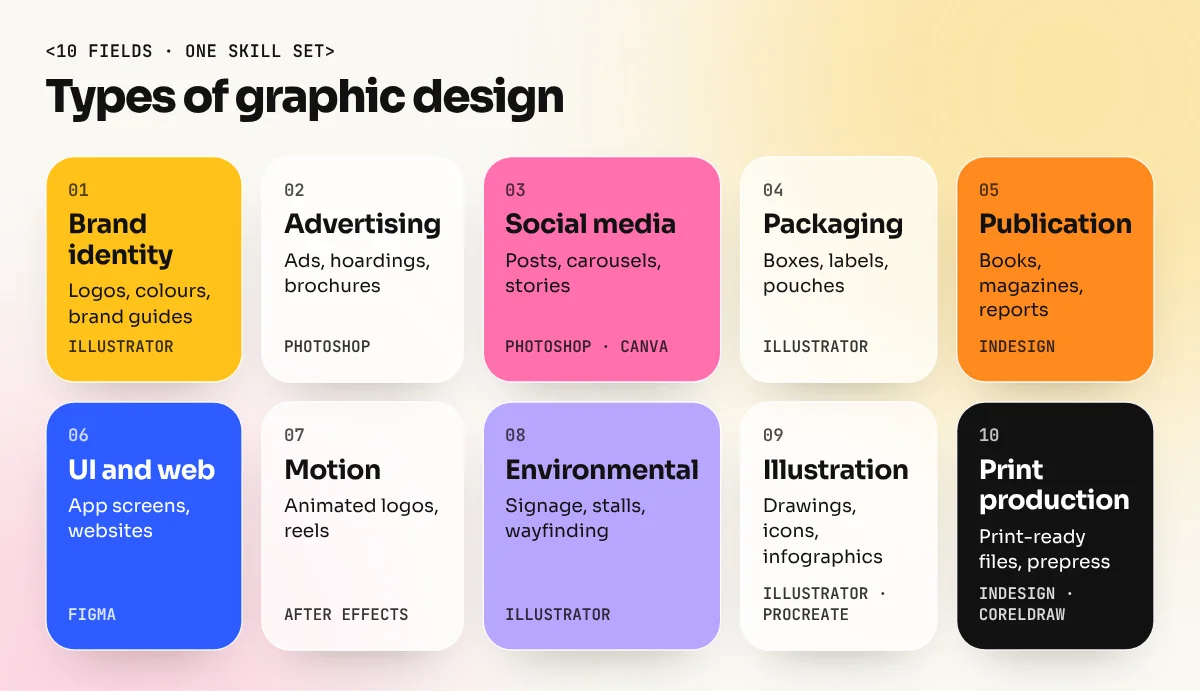
1 to 3: brand, advertising and social media
These three fields give the most work to new designers in India.
1. Brand identity design
Brand identity is how a business looks every time you meet it. The designer creates the logo, picks the colours and fonts and writes a short guide that tells everyone how to use them. Think of how a chai brand's kulhad logo, its yellow colour and its hand-drawn type appear the same on the cup, the shop board and the Instagram page.
Skills it needs: strong drawing of simple shapes, typography, research and the patience to explain your choices to a client. Portfolio piece: one full identity with a logo, colour palette, type, stationery and three uses in real life.
2. Marketing and advertising design
This is the classic agency job: print ads, hoardings, brochures, flyers and full campaigns. Famous Indian examples are the topical hoardings that a dairy brand has run for decades, where one idea and one line react to the week's news. The designer works with a copywriter, turns an idea into a layout and adapts it into many sizes.
Skills it needs: layout, image editing, headline type and speed. Portfolio piece: one campaign of three ads for the same product, plus a brochure or leaflet.
3. Social media design
Every business, from a sweet shop in Chandni Chowk to a fintech app, now needs posts, carousels, stories and video thumbnails every week. Social media design is often the first paid work for beginners because the projects are small and the volume is steady.
Skills it needs: fast layouts, a good eye for photos, simple motion and the ability to keep a brand's look the same across 30 posts. Portfolio piece: a month of posts for one brand, planned as a grid.
4 to 6: packaging, publication and UI
4. Packaging design
Packaging designers plan boxes, pouches, labels and bottles. The work joins branding, layout and print knowledge, because the pack must sell in a few seconds on a shelf and also carry all the legal details. India has a huge FMCG market, so namkeen, spice, tea and personal care brands hire packaging designers all the time. Our packaging design guide shows the full process.
Skills it needs: Illustrator, dielines, CMYK colour and real print checks. Portfolio piece: a range of three flavours with a flat dieline and a mock-up.
5. Publication design
Publication designers lay out magazines, books, newspapers, catalogues, school textbooks and annual reports. It is calm, detailed work built on grids, readable type and long documents. Delhi and Noida have many publishers and printers, so this field gives steady jobs.
Skills it needs: InDesign, master pages, styles and an eye for long text. Portfolio piece: an 8 to 12 page magazine or a company report.
6. UI and web design
UI (user interface) design is the look of apps and websites: buttons, screens, icons and layouts. It sits between graphic design and UX design, which is about how the product works for the user. The World Economic Forum's Future of Jobs Report 2025 listed UI and UX designers among the fast-growing roles, which is why many graphic designers now add Figma to their skills.
Skills it needs: Figma, grids, type for screens and basic user thinking. Portfolio piece: five screens of a simple app, such as a tiffin delivery app.
7 to 10: motion, environmental, illustration and print
7. Motion graphics
Motion designers make logos move, build explainer videos, title cards and animated reels. Short video now rules social media, so brands want designers who can animate as well as design. Most motion designers start as graphic designers and add After Effects.
Skills it needs: timing, After Effects and strong static design first. Portfolio piece: a 15-second logo animation and one 30-second explainer.
8. Environmental graphic design
This field puts design into real spaces: signboards, wayfinding in malls, hospitals and metro stations, shop interiors, exhibition stalls and event branding. The US Bureau of Labor Statistics describes this work as experiential graphic design, often done alongside architects and interior designers.
Skills it needs: large-scale layouts, clear type from a distance and knowledge of materials like flex, acrylic and vinyl. Portfolio piece: a sign system for a college campus or a café.
9. Illustration and infographics
Some designers mainly draw: book covers, editorial illustrations, icons, stickers and mascots. Others turn data into clear charts and infographics for news sites, reports and social posts. Both need a strong sense of shape and colour.
Skills it needs: drawing, Illustrator or Procreate and clear thinking about information. Portfolio piece: an icon set or one infographic that explains a real topic.
10. Print production and prepress
Before any design reaches a press, someone checks the bleed, the colour mode, the fonts and the image resolution. This is print production. It is less glamorous but very important and print houses across India hire for it. Many people in this role start as DTP (desktop publishing) operators.
Skills it needs: InDesign, Illustrator, CorelDRAW, CMYK and a careful eye. Portfolio piece: a before-and-after file that shows how you fixed a design for print.
Which type of graphic design suits you?
Use this simple guide. Pick the line that sounds most like you.
| If you enjoy... | Try this type first |
|---|---|
| Big ideas and catchy lines | Marketing and advertising |
| Simple, clever symbols | Brand identity |
| Quick, daily work and trends | Social media |
| Making things you can hold | Packaging |
| Reading and neat pages | Publication |
| Apps and how people use them | UI and web |
| Video and movement | Motion graphics |
| Spaces, buildings and events | Environmental |
| Drawing by hand | Illustration and infographics |
| Fixing details nobody else sees | Print production |
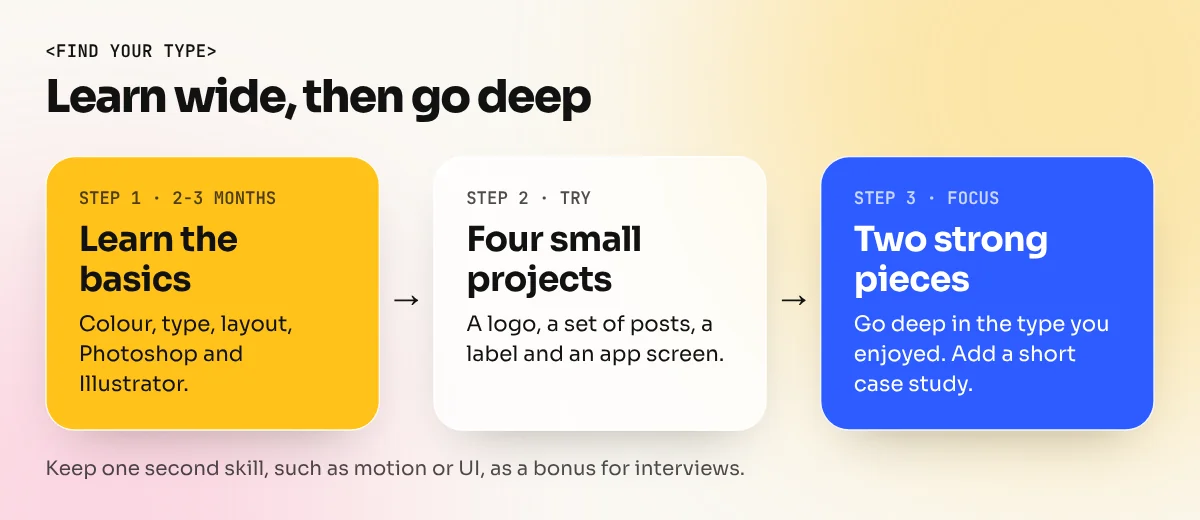
You do not need to decide on day one. A sensible path looks like this:
- Learn the common basics for two to three months: colour, type, layout, Photoshop and Illustrator.
- Try four small projects in different types, for example a logo, a social post set, a label and an app screen.
- Notice which one you enjoyed and which one people praised.
- Build two or three strong pieces in that type, with a short case study for each.
- Apply for jobs in that field and keep one second skill, such as motion or UI, as a bonus.
What all types of graphic design share
Every field above rests on the same core skills. If you learn these well, moving from one type to another is easy.
- Colour: how colours work together and how they change between screen and print.
- Typography: choosing and setting fonts so people can read them.
- Layout and grids: placing things so the eye moves in the right order.
- Software: Photoshop, Illustrator and InDesign as the base, then Figma or After Effects by field.
- The brief: understanding what the client needs before you open any software.
This is why a good course teaches the basics first and then lets you try different fields. Our 6-month graphic design diploma covers branding, advertising, social media, packaging and print with real projects. If brand identity or packaging is your target, the Adobe Illustrator course builds the vector skills those fields depend on.
The bottom line
There are many types of graphic design, but they grow from one set of skills. Start with the basics, test a few fields with small projects and then go deep in the one you enjoy most. That is how a beginner becomes a brand designer, a packaging designer or a UI designer with a portfolio that recruiters understand. For the job side, read our guide to graphic designer jobs in India.
Frequently asked questions
How many types of graphic design are there?
There is no fixed official number. Most designers group the work into 8 to 12 fields. This guide uses 10 common ones, from brand identity and advertising to UI, motion and print production. The lines overlap and many designers work in two or three.
Which type of graphic design is best for beginners?
Social media and marketing design are the easiest to start with, because the projects are small, the briefs are clear and there is steady work. They also teach you the basics fast. Once you are confident, you can move into branding, packaging or UI.
Which type of graphic design has the most jobs in India?
Marketing, advertising and social media design have the most openings, because every business now needs regular posts, ads and banners. Packaging, publication and print roles are steady in FMCG and printing hubs. UI and motion roles are growing with apps and video.
Do I need to choose one type of graphic design at the start?
No. Learn the common basics first and try small projects in three or four fields. After a few months you will know which work you enjoy. Then build two or three strong portfolio pieces in that field.