Graphic Design Subjects: The Full List for Diploma and Degree Courses
Graphic design subjects explained simply: theory, drawing, software, branding, print and portfolio, with a year-wise list for diploma and degree courses.
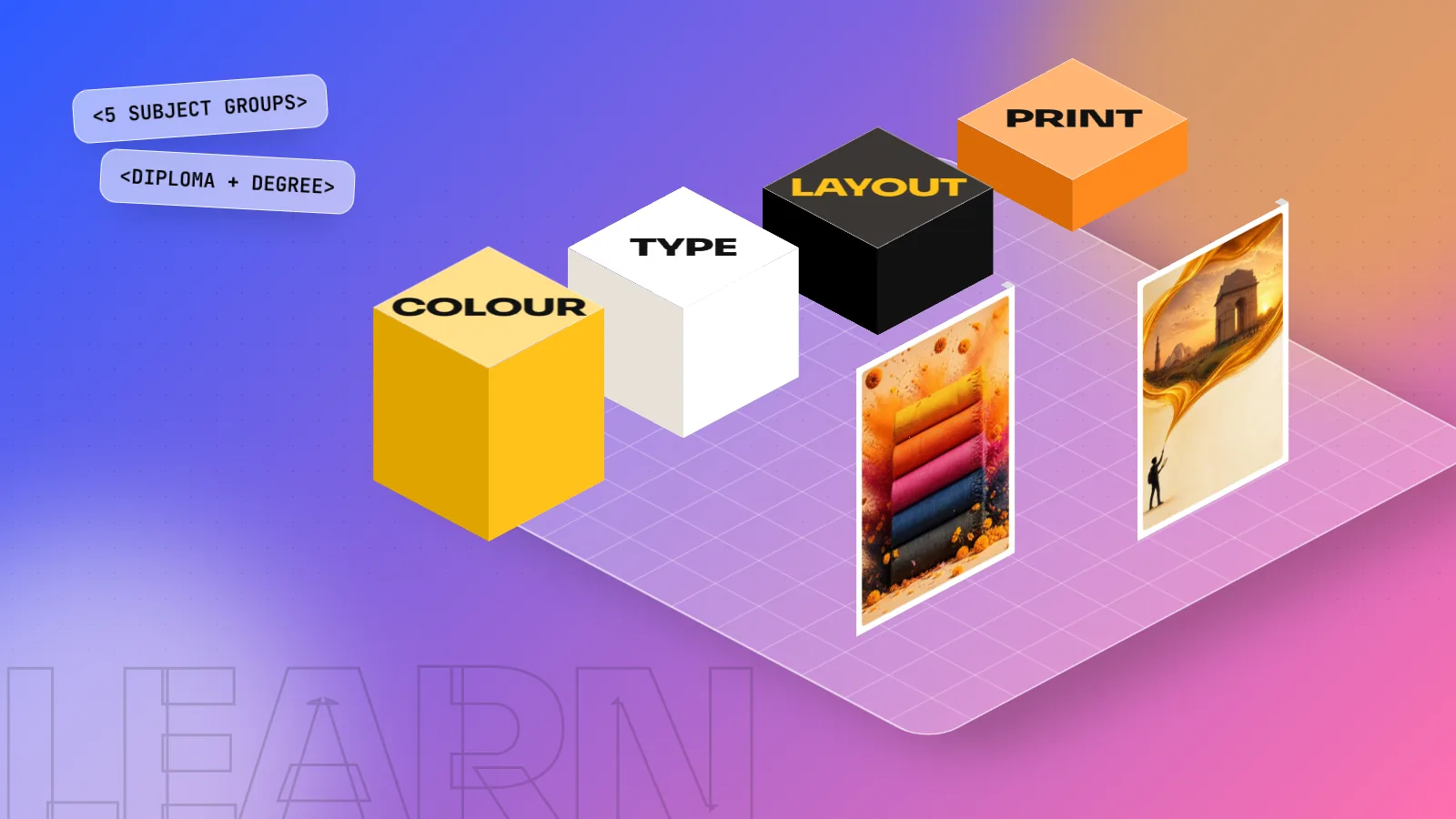
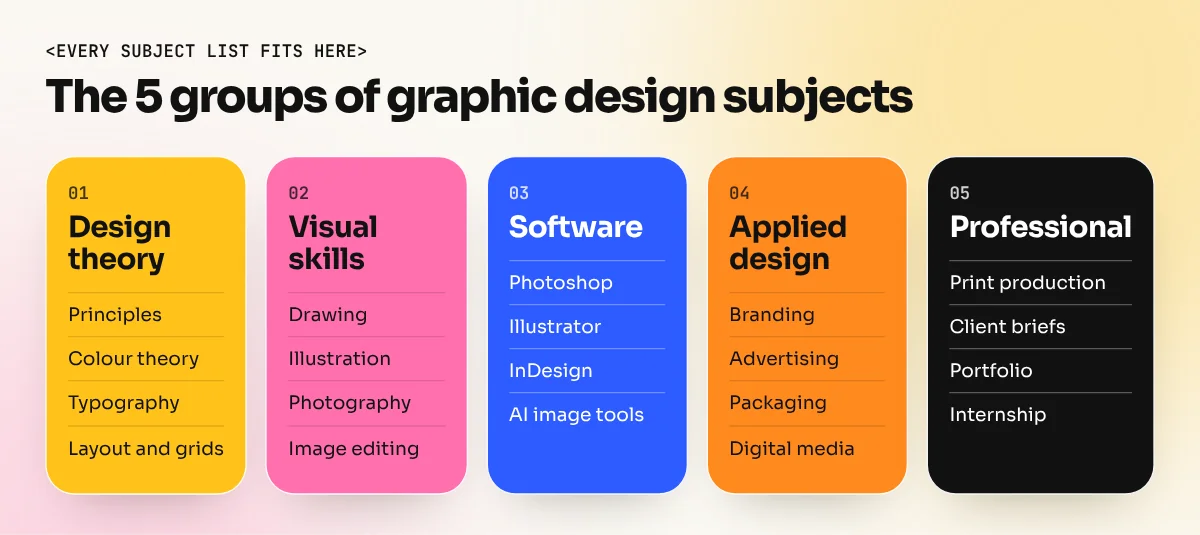
Graphic design subjects fall into five groups. Theory subjects (design principles, colour, typography, visual communication), drawing and photography, software (Photoshop, Illustrator, InDesign), applied subjects (branding, advertising, packaging, publication, digital media) and professional subjects (print production, portfolio, client briefs). Diplomas cover these in months. Degrees spread them over three or four years.
Graphic design subjects are the topics you study to become a working designer: design principles, colour, typography, layout, drawing, software such as Photoshop and Illustrator, branding, advertising, print production and portfolio work. The names change from course to course, but almost every serious programme in India teaches the same five groups. This guide lists each subject in plain words, explains why it matters and shows how a short diploma and a three or four year degree arrange them.
If you have seen a course brochure full of long subject names and wondered what they really mean, this page is for you.
The five groups of graphic design subjects
Every subject list, however it is worded, fits into one of these groups.
| Group | Typical subject names | What you actually learn |
|---|---|---|
| 1. Design theory | Design fundamentals, colour theory, typography, visual communication | Why a design works or fails |
| 2. Visual skills | Drawing, sketching, illustration, photography | How to plan and make your own images |
| 3. Software | Photoshop, Illustrator, InDesign, CorelDRAW, Canva | How to build the final files |
| 4. Applied design | Branding, advertising, packaging, publication, digital media | How to solve real business briefs |
| 5. Professional practice | Print production, portfolio, client briefs, internship | How to work and get hired |
A course that is strong in only one group is a warning sign. Software alone makes you an operator. Theory alone leaves you with no files to show. You need all five.
Design theory subjects
These are the subjects that train your eye. They come first in almost every course because everything else depends on them.
Design fundamentals or principles of design. Balance, contrast, alignment, repetition, proximity, hierarchy and white space. You learn why one poster is easy to read and another feels messy.
Colour theory. The colour wheel, harmonies, contrast, colour meaning and the difference between screen colour (RGB) and print colour (CMYK). A sweet shop box and a hospital sign need very different colours and this subject teaches you why.
Typography. Typefaces, font pairing, size, spacing between letters and lines and how to set clean paragraphs. Many students find it the hardest subject because the details are small, but it is the one clients notice most.
Layout and grids. How to place text and images on a page or screen using margins, columns and grids. This is what makes a magazine page or a social post look organised.
Visual communication. How images, symbols and words carry meaning. Degree courses often call parts of this "semiotics" or "communication theory". In simple words, it is about making sure your audience reads the message you meant.
History of art and design. Common in degrees, lighter in diplomas. You study movements such as the Bauhaus and Swiss style, plus Indian visual traditions like hand-painted film posters, truck art and old matchbox labels. It gives you a library of ideas to draw from.
Visual skills subjects
You do not need to be an artist to study graphic design, but you do need to put ideas on paper quickly.
- Drawing and sketching. Quick thumbnails, basic perspective and object drawing. The goal is planning, not fine art.
- Illustration. Turning sketches into finished artwork, by hand or in Illustrator. Useful for packaging, children's books and social media.
- Photography. Composition, light and basic camera settings. Designers often shoot their own product photos for small clients.
- Image editing. Retouching, cut-outs and compositing, usually taught together with Photoshop.
If drawing worries you, relax. Most students start with simple boxes and stick figures. What matters is that you can show an idea before you open the computer.
Software subjects
Software is where most of the class hours go in a job-focused course. Each program has a clear job.
| Software | Main use | Typical work |
|---|---|---|
| Adobe Photoshop | Photos and raster images | Ad visuals, social posts, retouching |
| Adobe Illustrator | Vector drawing | Logos, icons, packaging artwork |
| Adobe InDesign | Multi-page layout | Brochures, magazines, menus, books |
| CorelDRAW | Vector and print layout | Flex banners, visiting cards, wedding cards |
| Canva | Quick template-based design | Social posts and simple marketing material |
| AI image tools | Generating and editing images | Photoshop Generative Fill, quick concepts and variations |
In 2026 a good subject list also includes AI. Look for Photoshop Generative Fill and AI image tools taught alongside design basics, so you learn to judge and fix AI output rather than just press a button.
Applied design subjects
Once you know the theory and the tools, applied subjects put them to work on real types of projects.
- Branding and identity. Logo, colours, fonts and the rules that hold a brand together.
- Advertising design. Print ads, hoardings, digital banners and campaign ideas.
- Packaging design. Boxes, labels and dielines for products on a shelf.
- Publication design. Magazines, brochures, reports and books.
- Digital and social media design. Posts, stories, thumbnails and web banners in the right sizes.
- Introduction to motion and UI. Many courses now add a short unit on simple animation or screen design, so you know how your work moves into apps and videos.
These subjects usually run as projects. You get a brief, such as "launch a new kulhad chai brand in South Delhi" and you produce the full set of designs for it. Each project becomes a piece in your portfolio.
Professional practice subjects
These subjects turn a student into someone a studio can hire.
- Print production. Bleed, resolution, paper types, finishes and how to send a file a printing press can use without problems.
- Client briefs. Reading a brief, asking the right questions, presenting ideas and handling feedback.
- Portfolio building. Choosing your best work, writing short case studies and presenting them online and in print.
- Internship or live projects. Working on real jobs with deadlines.
- Interview preparation. Talking about your work, design tests and basic professional habits.
Students often skip over these subjects in a brochure, yet they decide how quickly you get your first job.
How subjects are arranged in a diploma and a degree
The same subjects appear in short and long courses. What changes is the depth and the order. The table below shows a common pattern. Exact names differ between universities and institutes, so treat it as a guide, not a fixed list.
| Course type | Typical length | How subjects are arranged |
|---|---|---|
| Software course | A few weeks per program | One tool at a time, small exercises |
| Diploma | Around 6 months | Theory and software first, then branding, print and portfolio |
| Three-year degree (such as BFA or BVoc) | 3 years | Year 1 foundation, year 2 core design and software, year 3 specialisation and project |
| Four-year design degree (such as BDes) | 4 years | Year 1 foundation, years 2 and 3 core and electives, year 4 internship and final project |
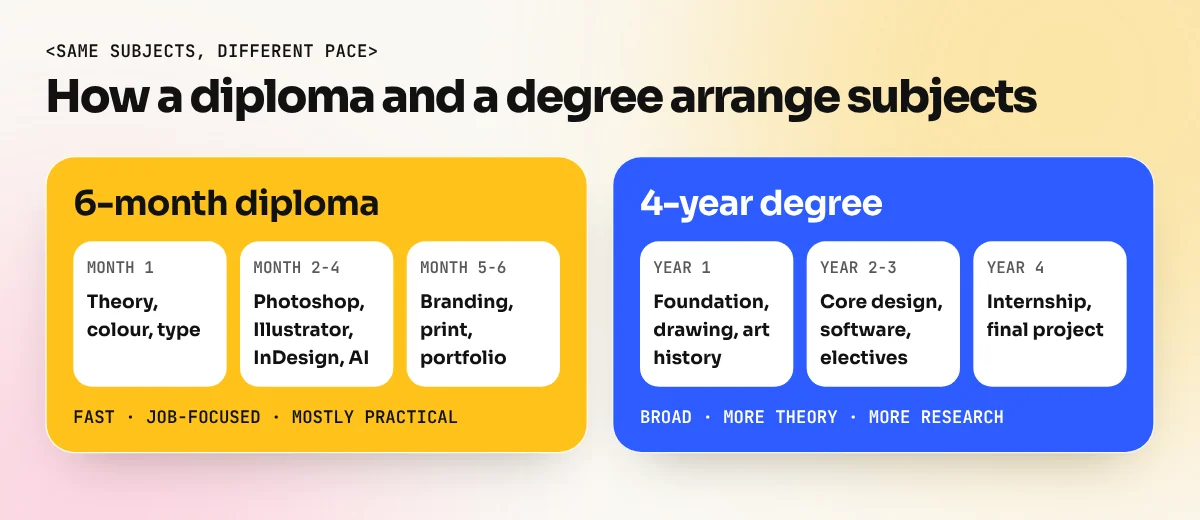
A degree spends more time on theory, art history, research methods and electives such as photography or illustration. A diploma moves faster and puts most hours into software, live briefs and the portfolio. Neither is "better" for everyone. If you want a job in months, a focused diploma suits you. If you want a broad education and have the time, a degree gives you more room to explore.
For a month-by-month view of a job-ready plan, read our graphic design course syllabus. Our 6-month graphic design diploma follows that order, from basics to a finished portfolio.
Which school subjects help
Students often ask which subjects they should have studied at school. The short answer is that any stream works.
| School stream | Helpful background | What to add |
|---|---|---|
| Arts or humanities | Drawing, fine art, languages | Software practice |
| Commerce | Marketing basics, business sense | Drawing and sketching practice |
| Science | Computer skills, logical thinking | Colour and typography study |
There is no compulsory school subject for most graphic design courses. A habit of sketching and looking closely at posters, packaging and shop signs in your own market will help more than any marksheet. If you are finishing class 12 now, our graphic design course after 12th is built for students starting from zero.
How to check a subject list before you join
Use this quick checklist when you read any course brochure or talk to a counsellor.
- Are all five groups there? Theory, visual skills, software, applied design and professional practice.
- Is typography a separate subject? If it is hidden inside "software", the course may be tool-only.
- Is print production taught? Many Indian jobs still involve printed work.
- Is AI included in the right way? Look for AI taught with design judgement, not as a replacement for it.
- Is there a portfolio subject with real briefs? You should leave with finished projects, not only exercises.
- How many hours are practical? Graphic design is learned by doing. Most of the time should be hands-on.
If a list ticks all six, the subjects are sound. Then compare the teachers' own work and the portfolios of past students. Those tell you how well the subjects are taught. To see how these subjects connect to actual jobs, our guide to the types of graphic design shows which subjects matter most for each career path.
Frequently asked questions
Which subjects are needed for graphic design after 12th?
Any stream is fine. Arts, commerce and science students all become designers. Drawing, art or computer subjects at school help a little, but no school subject is compulsory for most graphic design courses.
Is maths a subject in graphic design?
Not as a separate subject in most courses. You use simple measurement for grids, margins, print sizes and resolution, which is basic arithmetic. You do not need advanced maths.
Which graphic design subject is the hardest?
Most students say typography, because the rules are subtle and take practice to see. Others find the Illustrator Pen tool hard at first. Both get easier with daily practice on small projects.
Are graphic design subjects the same in a diploma and a degree?
The core is the same: principles, colour, type, layout, software and portfolio. A degree adds more theory, art history, research and electives over three or four years. A diploma focuses on job skills in a shorter time.