Design Inspiration: Where Designers Find Ideas Without Copying
Design inspiration made simple: where to look online and offline, a 5-step method to turn references into your own idea and where copying begins.
Design inspiration comes from collecting many references, studying why each one works and then using those reasons, not the look, in your own design. Look beyond design websites: streets, packaging, old posters, films and nature. Save 15 to 30 references, write what you like about each, then sketch at least 10 ideas before you open any software.
Design inspiration is the raw material for new ideas: the posters, signs, packages, photos and patterns you collect and study before you design. Good designers do not wait for inspiration to strike. They collect references on purpose, ask why each one works and then use that reason in their own work. The look stays with the original; the lesson comes with you. This guide shows where to find design inspiration, how to save it and a simple 5-step method to turn it into an original idea without copying.
Every designer has felt it. The brief says "a modern poster for a chai brand" and the blank artboard stares back. The answer is rarely "be more creative". It is "feed your eyes first, then think".
Inspiration vs copying: where is the line?
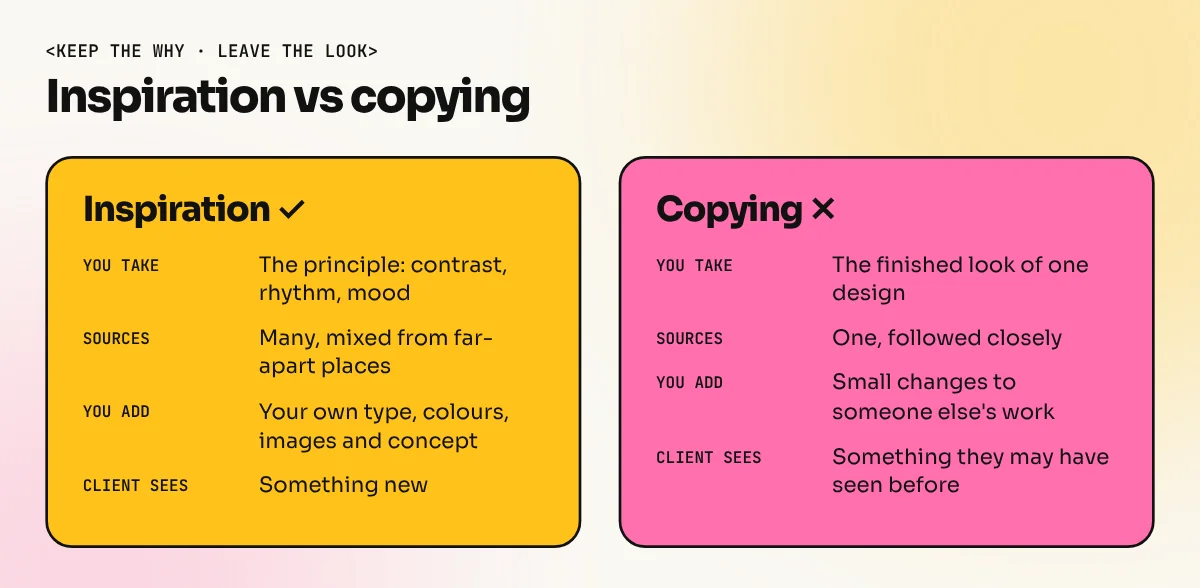
Before we talk about sources, be clear about the line. Copying is taking the visible result of someone's work: their layout, their illustration, their exact colour palette and type. Inspiration is taking the idea behind it: why the contrast works, why the grid feels calm, why the headline grabs you.
| Inspiration | Copying | |
|---|---|---|
| What you take | The principle (contrast, rhythm, mood) | The finished look |
| Number of sources | Many, mixed together | One, followed closely |
| Your own input | New type, colours, images, concept | Small changes to someone else's work |
| Client sees | Something new | Something they may have already seen |
| Risk | None | Lost trust, copyright trouble, a weak portfolio |
A quick test: if the original designer saw your work next to theirs, would they say "that is mine"? If yes, it is copying. If they would only say "I see we both like bold type", you are fine.
Where to find design inspiration online
Online sources are fast and searchable. Use them, but know what each one is good for.
| Source | Best for | Watch out for |
|---|---|---|
| Behance | Full case studies: logo, brand and packaging projects shown step by step | Very polished work can make you feel slow. Study the process, not just the result |
| Mood boards, colour ideas, quick visual searches | Many pins have no credit. Do not use pins as final assets | |
| Dribbble | Icons, UI, small illustrations and motion | Lots of trendy work that looks the same |
| Real client work by Indian studios and brands | The feed decides what you see. Save posts into named collections | |
| Font and type sites | Type specimens and pairing ideas | Check the font licence before using it in client work |
| Museum and library archives | Old posters, prints, maps and typography | Some images are free to study but not free to reuse |
Behance is owned by Adobe and is also where many designers keep their portfolio. If you are building yours, our guide to a Behance portfolio shows how to present projects the way the best case studies do.
Offline inspiration: the most underused source
The internet shows everyone the same top posts, so ideas that come only from screens start to look alike. The fix is to look at the real world. India is full of visual ideas most designers walk past:
- Street lettering. Hand-painted truck art, shop boards in Chandni Chowk, dhaba menus written on walls. Look at how letters are spaced and how colour is used with no budget at all.
- Packaging on shop shelves. Spend 15 minutes in a kirana store. Notice which pack you see first and why. Is it colour, size or a face?
- Old film posters and matchbox labels. Strong hierarchy, bold colour and confident type, from long before software.
- Hoardings and metro ads. Count how many words each one uses and how far away you can read it.
- Nature and architecture. The pattern on a peacock feather, the jaali screens at Humayun's Tomb, the shadows in a Lodhi Garden archway.
- Other art forms. Music album art, theatre sets, textile prints from Rajasthan, cinema colour grading.
Keep your phone ready. Take a photo, then write one line under it about what caught your eye. That single line is what turns a pretty picture into a lesson you can use.
How to save and organise references
A pile of 400 random screenshots is not inspiration. It is clutter. Organise as you collect:
- Make a folder or board per project, not one giant "inspo" folder.
- Sort references into groups: type, colour, layout, imagery, mood.
- Write a note on each one. "Love the huge number on a small page." "Two colours only, still feels rich."
- Keep the source. Note who made it so you can credit or check it later.
- Clean up monthly. Delete what no longer excites you.
The natural next step is a mood board, a single page that pulls your best references together to show a client the feeling before you design. Our guide to making a mood board covers that step by step.
A 5-step method to turn references into an original idea
Here is a simple method that works for posters, logos, social posts and packaging alike.
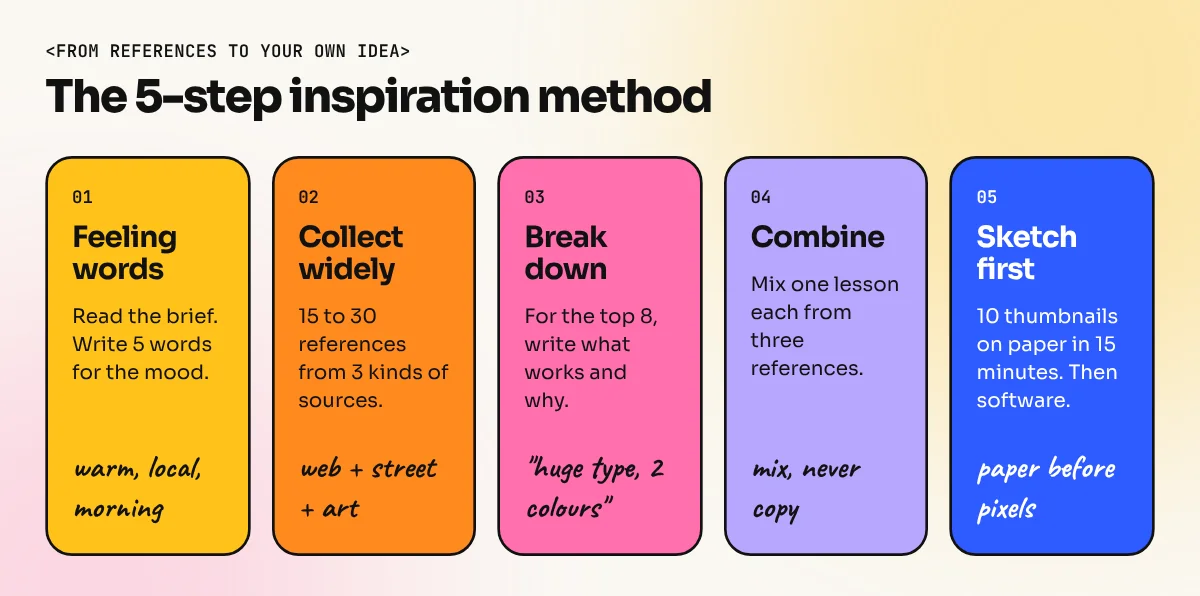
- Read the brief and write 5 feeling words. For a chai brand: warm, local, morning, honest, quick. These words guide your search, not the product name.
- Collect widely. Find 15 to 30 references from at least three kinds of sources: one design site, one offline photo set and one unrelated art form.
- Break each one down. For your top 8, write what works: colour, type, layout, image style or idea. Be specific.
- Combine, do not copy. Mix one lesson from each of three references. The warm colour of a kulhad, the bold type of an old film poster and the empty space of a Japanese print. That mix is yours.
- Sketch before software. Draw at least 10 tiny thumbnail ideas on paper in 15 minutes. Pick the best two and only then open Illustrator, Photoshop or Canva.

In this short video, the designer behind Satori Graphics shows three ways to generate ideas once your research is done: list storming, the 100 thumbnail approach and mind mapping. They fit neatly into steps 4 and 5 above.
Build an inspiration habit
Inspiration works best as a daily habit, not a panic search the night before a deadline. A simple routine:
| Time | Habit | Why it helps |
|---|---|---|
| 10 minutes daily | Save 3 references with a one-line note | Builds a library you can search later |
| Once a week | Redesign one ad or poster you saw, in your own style | Turns looking into doing |
| Once a month | Visit a market, museum, bookshop or exhibition | Breaks the screen bubble |
| Every project | Start with feeling words, not a Pinterest search | Keeps the idea tied to the brief |
Redesign exercises are also great portfolio material. If you need prompts, our list of graphic design ideas gives practice briefs for beginners.
In a structured course, this habit is part of the work. In our graphic design diploma, trainers ask students to show their references and sketches before the final design, so the idea is checked before the polish. The Illustrator course then helps you turn those sketches into clean vector work.
Common mistakes with design inspiration
- Starting with one reference. One source almost always leads to copying. Use many.
- Searching the product, not the feeling. "Chai poster" shows you 100 chai posters. "Warm morning ritual" shows you far more interesting things.
- Following trends only. Trends date fast. Mix in older work and offline sources.
- Using images you found as final assets. References are for study. Use your own photos, licensed stock or your own illustrations in the final design.
- Scrolling instead of designing. Set a timer. After 30 minutes of collecting, stop and sketch.
The bottom line
Design inspiration is not luck. It is a habit of looking widely, saving with notes and asking why something works. Keep the reason, leave the result and always sketch your own ideas before you touch software. Do that for every project and your work will start to look like yours, not like the top post on Pinterest.
Frequently asked questions
Where do graphic designers get inspiration?
From many places at once: design sites like Behance and Pinterest, but also shop signs, packaging, old film posters, books, museums, nature and other art forms like music and photography. The best ideas usually come from mixing sources that are far apart.
Is it okay to copy a design for inspiration?
Copying a design to practise in private is a normal way to learn, but never publish it or show it to a client as your own. For real work, take the reason a design works, like its contrast or its grid. Then build your own version with your own type, colours and images.
How many references should I collect before designing?
About 15 to 30 good references is enough for most projects. Fewer and you tend to copy one; more and you waste time scrolling. Collect from at least three different kinds of sources.
What do I do when I have no design inspiration at all?
Go back to the brief and write five words that describe the feeling the client wants. Then search those words, not the product. Step away from the screen for a walk, or sketch 20 tiny thumbnails fast without judging them. The block usually breaks within the first ten.