Online vs Offline Graphic Design Course: An Honest Comparison
Online vs offline graphic design course compared on feedback, cost, travel, discipline, software and jobs. A simple checklist to pick the right one for you.
Neither is better for everyone. An offline classroom course suits beginners who need daily routine, face-to-face correction and a shared lab. A live online course suits people who live far away, work fixed hours or already own a good laptop. Choose live teaching with screen-share feedback either way and avoid courses that are only recorded videos.
The online vs offline graphic design course question has no single right answer: it depends on where you live, how you learn and what equipment you have. A classroom course gives you routine, a shared lab and a trainer next to your chair. A live online course saves hours of travel and fits around a job. Recorded-video courses are a third option and they are the weakest for beginners. This guide compares the three honestly, lists who each one suits and gives you a checklist to decide in ten minutes.
Three formats, not two
When people say "online course" they mean two very different things. It helps to separate them first.
| Format | How it works | Feedback on your work |
|---|---|---|
| Offline classroom | You sit in a lab with a trainer and other students | Instant, the trainer looks at your screen |
| Live online | A trainer teaches on video call at a fixed time and you share your screen | Instant or same day, during the class |
| Recorded videos | You watch lessons whenever you like | Slow or none, often only through a chat group |
Most of the arguments against online learning are really arguments against recorded videos. A live online class with screen sharing is much closer to a classroom than to a YouTube playlist. Keep that in mind as you read the rest.
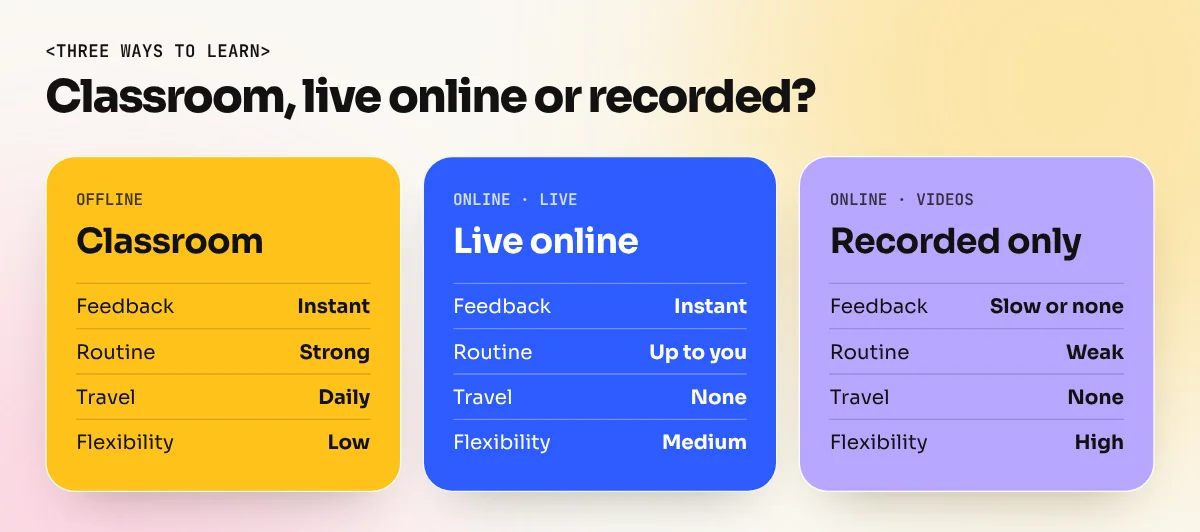
Online vs offline: side by side
Here is how the two main options compare on the things that decide whether you finish the course with a strong portfolio.
| Point | Offline classroom | Live online |
|---|---|---|
| Correction while you work | The trainer walks to your desk | The trainer watches your shared screen |
| Daily routine | Strong. You leave home, you work | Depends on you. Easy to skip a day |
| Travel | Metro or bus time every day | None |
| Equipment | Lab computers with software installed | Your own laptop, software and internet |
| Batchmates | You see their work and learn from it | Fewer casual chats, but group reviews still happen |
| Print work | You can see and touch test prints | You must print locally or trust screen previews |
| Timing | Fixed batch slots | Fixed slots, but no travel makes evening batches easier |
| Best for | Fresh 12th pass students, people who like structure | Working people, students in other cities, parents at home |
Neither column wins everywhere. The right choice is the one where the weak points matter least to you.
When an offline classroom is the better choice
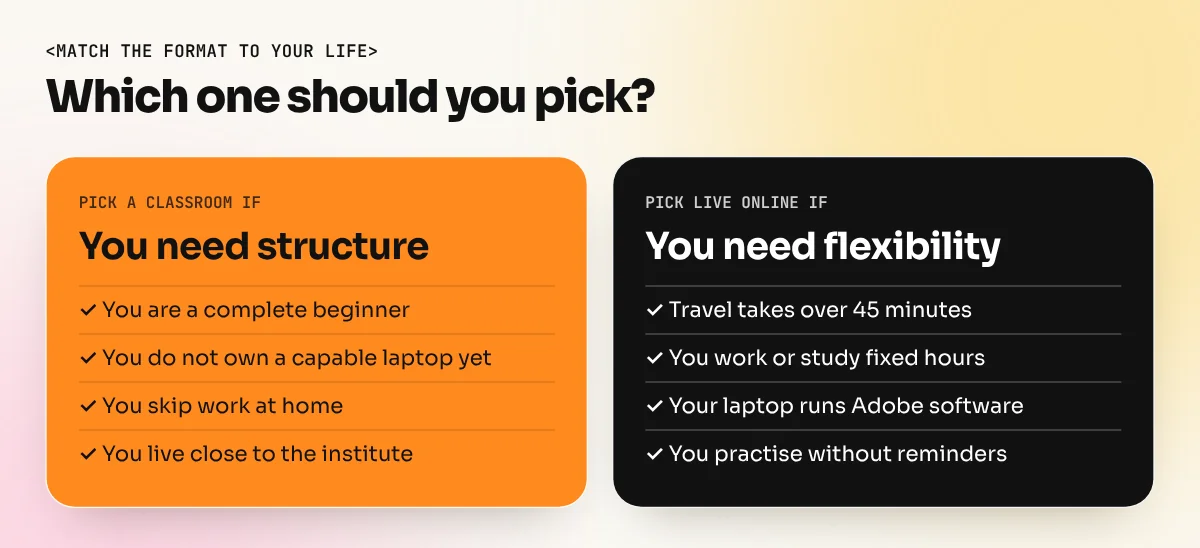
Pick a classroom course if most of these are true for you:
- You are a complete beginner. Early mistakes in Photoshop layers, Illustrator paths and InDesign text frames are easier to fix when the trainer can point at your screen and take the mouse for ten seconds.
- You struggle with routine at home. If you know you will open the laptop and end up on your phone, a fixed seat in a lab helps.
- You do not own a capable laptop yet. Adobe software needs a reasonably powerful machine. A classroom lets you start now and buy later, after you know what you need. Our guide on choosing a laptop for graphic design explains what to look for.
- You want to learn print by touch. Paper weight, a spot UV finish on a visiting card or how a poster looks at A2 size are easier to understand in your hands.
- You learn from people around you. Seeing how the student next to you solved the same brief is a quiet but powerful way to improve.
When a live online course is the better choice
A live online course makes more sense if most of these are true:
- The travel would eat your day. Two hours a day in Delhi traffic, from Noida or Gurgaon for example, is ten hours a week you could spend designing.
- You work or study at fixed hours. Evening or weekend batches are far easier to keep when you only need to open a laptop.
- You already have a laptop that runs Adobe software and a stable internet connection.
- You live outside the city or move often for work.
- You are disciplined about practice. Online works best for people who finish assignments without being reminded.
Online students also learn one useful job skill by default: working with clients and art directors over video calls and shared files. Many design jobs, especially freelance and work-from-home roles, run exactly like that.
The format matters less than these five things
Students often spend weeks deciding online or offline and five minutes checking the things that actually decide the result. Ask every course these questions, whatever the format:
| Question to ask | A good answer sounds like |
|---|---|
| Is teaching live or recorded? | Live, with a trainer who sees your work |
| How is my work checked? | Every assignment gets feedback, with corrections shown on screen |
| What will I have at the end? | A portfolio of real projects: logo, branding, poster, packaging, social posts |
| Which software is covered? | Photoshop, Illustrator, InDesign, CorelDRAW or Canva, plus AI tools inside them |
| What happens after the course? | Portfolio review, interview preparation and job support |
If a course cannot answer these clearly, the format does not matter. If it answers them well, both formats can work.
Cost: add up the full picture
The fee is only one part of the cost. Before you compare, write down both sides for your own situation.
Offline costs usually include the course fee, daily travel, food outside and the time spent on the road. Online costs usually include the course fee, a laptop that can run Adobe software, a reliable internet plan, a headset and sometimes a software subscription for home practice.
For a student who already owns a good laptop and lives far from the institute, online is often cheaper overall. For a student with no laptop who lives close by, the classroom is often cheaper for the first few months. There is no general rule, so do the sum for yourself.
A simple way to decide
Answer these five questions with yes or no:
- Do I live more than 45 minutes from the institute?
- Do I already own a laptop that runs Photoshop and Illustrator smoothly?
- Do I have a job or college at fixed hours?
- Do I finish tasks at home without someone checking on me?
- Am I comfortable learning on video calls?
If you said yes to four or five, a live online course will probably suit you. If you said yes to two or fewer, start in a classroom. If you are in the middle, ask for a trial class in both formats and see where you learn more in one hour.
Whatever you pick, your plan for learning should be the same: basics first, then software, then real projects. Our step-by-step guide on how to learn graphic design lays out that order.
How we run both at our South Extension institute
We teach the same syllabus in both formats. The 6-month graphic design diploma runs in our South Extension classroom and the live online graphic design course follows the same projects with a trainer who sees your screen and corrects your work during class. There are no recorded-only batches. You can talk to us about which format fits your week before you join.
The bottom line
Offline is better when you need routine, a lab and hands-on correction. Live online is better when travel, work hours or distance would stop you from attending. Recorded videos alone are rarely enough for a beginner. Choose the format you will actually keep up for six months, then judge the course on live teaching, feedback and the portfolio you will finish with.
Frequently asked questions
Is an online graphic design course valid for jobs?
Yes. Design studios and agencies hire on your portfolio and a short test, not on whether you sat in a classroom. What matters is the quality of the projects you finish and how well you can explain them.
Can a complete beginner learn graphic design online?
Yes, if the classes are live and the trainer checks your screen. Beginners struggle most with recorded videos, because nobody notices small mistakes in tools like the Pen tool or layers until they become habits.
Which is cheaper, online or offline?
The course fee is often similar. Online saves travel time and money, but you need your own laptop that runs Adobe software and a stable internet connection. Add both sides up before you decide.
Can I switch from online to classroom later?
Many institutes allow it when the syllabus is the same. Ask before you join, so you know whether you can move batches if your work hours or home address change.